PMA Films: Filmmaker Ian Cheney joins us to discuss ‘The Work in Progress,’ plus ‘Fjord’ and much more!
October 16, 2026
Chronovisor
The first feature film by Kevin Walker and Jack Auen, Chronovisor is to these eyes the great American indie of the year so far, and one of my favorites of the year in general. It’s a highly original and unexpectedly gripping thing, a literary conspiracy thriller shot on 16mm film that’ll hit like a drug for any analog fetishists. Starring Anne-Laure Sellier (a professor in her real life) as an academic working on a project about memory, Chronovisor traces her discovery of a device rumored to have the power to give any moment in history visual form, through the capture of residual light waves and electromagnetic radiation. The creation of this device is an existing conspiracy theory – the Chronovisor is rumored to have been suppressed by the Vatican – and the film is based on actual research.
Much of the film consists of Sellier alone at home or in gorgeous library study rooms and archives, poring over books, tapes, and other materials. Walker and Auen devise brilliant ways to visualize the professor’s study: superimposing translated text over its foreign source, along with lovely tricks of editing. Its effect is to give the viewer the same rush of discovery as the film’s mysterious protagonist, as she gets closer and closer to the “truth”; at points, you simply can’t believe you’re so compelled by a film that asks you to spend so much time looking at the written word. Chronovisor is a dazzlingly imagined and resourceful film, one that’s both a respite from and a complement to our modern conspiracy cultures.
American Doctor
From Emmy® Award-winning filmmaker Poh Si Teng, American Doctor follows three American physicians— Palestinian, Jewish, and Zoroastrian—united by a single oath to save lives. After volunteering in besieged hospitals in Gaza, they return home determined to fight for the patients and colleagues they left behind, taking their battle from the front lines of war to the halls of Congress.
“A Few Small Odysseys”: The Swimmer (1968)
Adapted from the legendary short story by John Cheever, Frank Perry’s The Swimmer continues our fall film series, “A Few Small Odysseys.” It’s a remarkable piece of early New American Cinema, starring the great Burt Lancaster as a suburban husband and Mad Men-era ad man who decides he’ll journey home from a party by swimming his way back through the pools in the neighborhood. This whimsical quest takes on an existential and eventually surreal tilt, too odd to be considered merely an exploration of mid-century masculinity. Perry is best known for directing Mommy Dearest, but I’ve been enjoying digging a little deeper in his catalog of late. I highly recommend checking out his follow-up to The Swimmer, Last Summer, a unique and upsetting coming-of-age film which was just released on Blu-ray by Warner Archive and has a similarly destabilizing power.
Screening Times and Tickets:
NAZA
Shot at night on the rooftops of Tel Aviv, NAZA is directed by Yuval Abraham and Rachel Szor, two of the four co-directors of the 2024 Oscar-winning documentary No Other Land, and produced by the Guardian and James Wilson (JW Films) and executive produced by Jonathan Glazer. Wilson and Glazer are the Oscar-winning team behind The Zone of Interest.
The Work in Progress (with filmmaker Ian Cheney)
We’re thrilled that director Ian Cheney can join us for this Sunday’s screening of The Work in Progress. This documentary is something of an offshoot of last year’s hit The Last Class, which followed Robert Reich through his final semester of teaching at Berkeley. With questions devised by Reich, Cheney and his crew toured the country interviewing Americans young and old about their interpretation of the American experience: where it’s been, where it is, and where it could go. It’s a refreshing concept for a heightened political season, and an unusual opportunity to hear perspectives from the film’s broad swath of participants, who speak expansively about their experience, ideals, and dreams.
Fjord
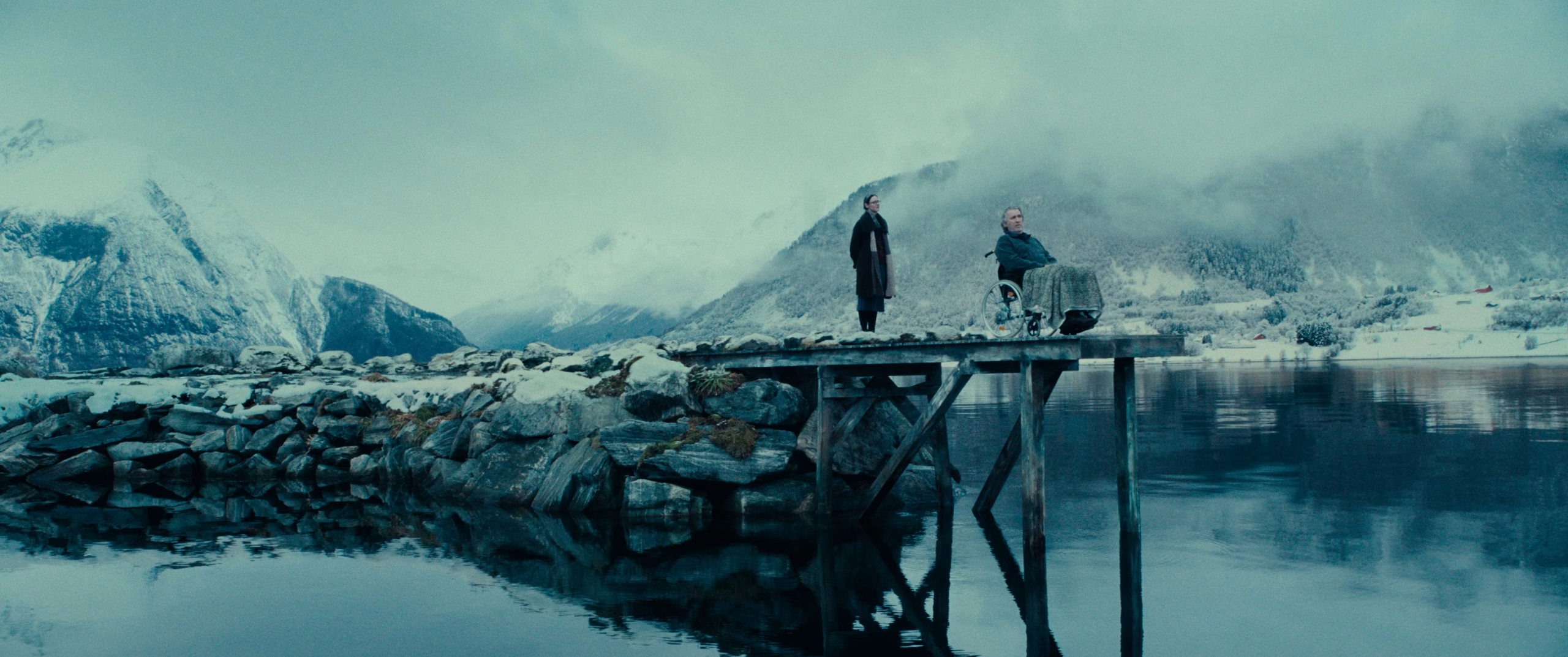
Winner of the Palme d’Or at this year’s Cannes Film Festival, Fjord is the first feature not set in Romania by the great director Cristian Mungiu, who previously won a Palme for 4 Months, 3 Weeks and 2 Days and has since cranked out a remarkably consistent and urgent set of film’s about place and belonging in a changing Europe. Fjord stars Sebastian Stan and Renate Reinsve as a devout married couple (she is Norwegian, he is Romanian) who relocate to a small Norwegian town. Their religious convictions stand out in progressive Norway, and rise to the forefront after an incident with one of their children draws the attention of local authorities. Tense and provocative, the film finds Mungiu exploring the line where personal beliefs conflict with broader social values.
The Innocents
For Halloween, a perfect treat. The Innocents is Jack Clayton’s 1961 adaptation of Henry James’s classic, The Turn of the Screw, starring Deborah Kerr as a governess left mostly along at a country estate with two young charges. Initially bewildered by the children’s mysterious bond, the governess becomes increasingly fearful the grounds are haunted at the children may be possessed. This is an exquisite film, classically economical in its storytelling and delicately adorned with modernist techniques like deep focus photography and expressionistic lighting, all gorgeously calibrated to a story rooted in repression. It’s one of the great classy chillers.
Past Screenings
Champlain Film Festival
Next weekend, we’re happy to again cede the screen to our friends at Alliance Française du Maine, who will present the fifth annual Festival Champlain/Champlain Film Festival, an eclectic celebration of international Francophone cinema. This year, look out for some special live virtual conversations with filmmakers, as well as a post-film discussion featuring our own Deputy Director and Head of Art and Exhibitions, Andrew Eschelbacher after a screening of Colors of Time on Thursday, October 15 at 5:30 pm. For tickets, a schedule, and more information, visit the festival’s website here.
Aanikoobijigan [ancestor / great-grandparent / great-grandchild] (Free Screening)
For Indigenous Peoples Day, we’re offering a free screening of the excellent new documentary by Ojibway filmmakers Adam and Zack Khalil. Aanikoobijigan [ancestor / great-grandparent / great-grandchild] follows the work of Michigan Anishinaabek Cultural Preservation & Repatriation Alliance, a group of repatriation specialists attempting to recover ancestral remains and belongings from institutions in Michigan and beyond. Winner of an audience award at Sundance this year, the film looks to hit theaters in 2027.
Howl’s Moving Castle (2004) (Presented with Portland Symphony Orchestra)
We’re delighted to partner with Portland Symphony Orchestra on a film screening for the first time. This weekend, the PSO will perform “The Music of Studio Ghibli” twice at Merrill Auditorium, and we’ll feature one of the films their concert will cover: Hayao Miyazaki’s 2004 gem, Howl’s Moving Castle. We’re especially grateful to guest conductor Morihiko Nakahara, who will begin the screening with a brief discussion of this music. Anyone with a ticket to the PSO concerts will receive a coupon code to attend this screening for free.
“A Few Small Odysseys”: Good Time (2017)
“A Few Small Odysseys,” our fall film series devoted to quests great and small, continues with Josh and Benny Safdie’s Good Time, perhaps the first film that made many of us pay serious attention to matinee idol Robert Pattinson as one of our more daring and interesting actors. (With the current Primetime, he continues to live up to the hype.) I think Good Time is the Safdies’ masterpiece, a frenzied race through New York City after small-time criminal Connie (Pattinson) and his brother Nick (Benny Safdie) go through a disastrous bank robbery. Featuring a beguiling mix of stars and non-professionals, a bold color palette captured with run-and-gun energy, and a subtle and frank examination of racial privilege and power dynamics, it’s a movie that feels like New York in a way that hearkens back to After Hours and other NYC crime classics.
Ha-Chan, Shake Your Booty!
The big crowd-pleaser at this year’s Sundance Film Festival (and winner of its Directing award), Ha-Chan, Shake Your Booty! stars Oscar nominee Rinko Kikuchi as Ha-Chan, a wildly successful ballroom dancer with her partner Luis, who dies unexpectedly and leaves Ha-Chan in search of hope and inspiration. Director Josef Kubota Wladyka keeps the story both grounded and imaginative, tethering us to Ha-Chan’s state of mind by way of creative flights into her psyche as she gradually reenters the world of dance and develops feelings for her new instructor.
“Makers at the Movies”: Mean Girls (2004)
We’re delighted to welcome back Portland’s craftiest audience to our “Makers at the Movies” series, presented with Olde School Fiber & Craft and the Maine Playweek. As sweater weather looms, so does “Mean Girls Day,” informally celebrated on October 3. Mean Girls is, somehow, still one of the last major high school films, sharply written by Tina Fey and a timeless evocation of adolescent life. As usual, all attendees are encouraged to bring an art or craft project with them to the screening (no wet materials permitted, please), and we’ll keep the lights up a bit for you.
Out at Six (Presented with Finding Our Voices)
Finding Our Voices joins us next Friday evening to present a special community screening of the new documentary Out at Six, directed by Livi Kessel. This brave and cathartic film (which runs under an hour) chronicles Kessel’s teenage relationship with an older man, told through the voice of both the filmmaker and her loved ones, all mapped alongside research about the progression of domestic violence. Finding Our Voices has coordinated a panel of survivors and experts who will speak on the many issues raised by the film after the screening. Registration is pay-what-you-want for this event.
“A Few Small Odysseys”: Stalker (1979)
Our fall film series, “A Few Small Odysseys,” continues with one of cinema’s most formidable objects, Andrei Tarkovsky’s totemic 1979 film Stalker, certainly one of the major films about a few guys on a freelance gig. Here, a writer and professor are guided by a “stalker” into the “Zone,” a land of rare and dangerous beauty positioned in contrast to the film’s stark, post-apocalyptic reality. The Zone is rumored to contain a “Room” that will reveal its visitors’ greatest desires. It remains mind-blowing that Tarkovsky’s film was made well before the disaster at Chernobyl, which the overgrown terrain of the Zone cannot help but evoke, but Tarkovsky’s film is an endlessly mutable metaphor, surely conjuring the gulag, the 1970s’ sense of spiritual decay, and many other mysteries. This one is unmissable.
The History of Concrete
I’m so happy to see excellent pre-sales for this, one of my most anticipated movies of the year. John Wilson is a singular storyteller, most prominently showcased in his divine three-season HBO cult hit, How To with John Wilson. There, Wilson took broad concepts for episodes – “How to Make Risotto,” “How to Improve Your Memory” – and turned them into wide-ranging, often intimate, always hilarious explorations of modern existence. The backbone of his work is a remarkable archive of mundane, uncanny footage he has captured in the streets of New York City, which lends a humorously poetic quality to his aw-shucks narration. The new History of Concrete is essentially a super-sized episode of his show, in which Wilson explores the ubiquity and fragility of one of the world’s most common substances, while simultaneously considering how to make a marketable, compelling film about it. It’s a thoughtfully digressive gem, and Wilson is one of the only filmmakers I can think of whose work so strongly evokes the here and now: he is always reminding us that we are mutual citizens of a big, flawed, remarkable world.
The Marching Band
A massive crowd-pleaser at last year’s Champlain Film Festival in our auditorium, Emmanuel Courcol’s The Marching Band is currently winning over large arthouse audiences upon its US theatrical release. (Even the trailer has been killing here.) The film reunites two brothers separated at birth: One as a famous classical conductor, the other works in a school cafeteria, but both are bonded by their ear for music.
How to Divorce During the War
Lithuania’s selection for the Best International Feature category at next year’s Academy Awards, Andrius Blaževičius’s excellent How to Divorce During the War arrives with a fine pedigree, including a Best Director award at this year’s Sundance Film Festival. Set in Vilnius as the war in Ukraine is about to begin in earnest, the film tracks a family of three as they simultaneously reckon with a domestic rift and a geopolitical schism that drastically reshapes life in Lithuania. Fans of Ruben Östlund will enjoy this one, which quite deftly depicts its protagonists with a blend of empathy and skepticism. It’s expertly done all around.
[AT CONGRESS SQUARE PARK]: “Eve Biddle Selects”: Who Framed Roger Rabbit (1988) (Free Screening)
We’ll be hanging with our pals at Congress Square Park to wrap up our series of films curated by Eve Biddle, and we conclude with a gem. Robert Zemeckis’s Who Framed Roger Rabbit (one of the first movies I remember seeing in a theater) is a still-astonishing live-action/animation hybrid and an ageless blend of Chinatown and Looney Tunes chaos. The feature will kick off but before that, we’ll screen Joshua Frankel’s “animated impossible architectural proposal” “Plan of the City” at about 6:45 pm. This is a free event in Congress Square Park.
Pee Shy + Unless Something Goes Terribly Wrong (with filmmaker Steven Jackson)
Delighted to find another excuse to show the smash local documentary Unless Something Goes Terribly Wrong – now the most popular film in our auditorium since 2020 – and I’m even more delighted to be joined by filmmaker Steven Jackson to screen his incredibly winning short, Pee Shy. Sweet and intimate, the short follows Jackson as he attempts to reckon with a lifetime of shy bladder syndrome through techniques both mental and social (I’m loath to say more). For this event, we’ll screen Jackson’s short and have a brief Q&A before wrapping things up with Unless Something Goes Terribly Wrong.
“A Few Small Odysseys”: Mikey and Nicky (1976) (New 4K Restoration)
Elaine May has one of the great miniature filmographies in the history of American film, from the inimitable dark comedies The Heartbreak Kid and A New Leaf to the legendary Ishtar, but her most influential film these days is surely Mikey and Nicky, starring John Cassavetes and Peter Falk as small-time gangsters on the lam over the course of one crazy night in Philadelphia. Tales of this production are legion: May shot over a million feet of film, pleased to watch her two stars improvise; Paramount was unhappy with May’s decision-making and initial cuts, so May absconded with two crucial reels of film and hid them in a garage until the studio acceded to her demands. The result is a comic, tragic, and frenzied tale of failures, friendship, and mistakes, its singular energy finding new life with directors like the Safdies. We’ll explore some of the children of Mikey and Nicky in our fall film series “A Few Small Odysseys,” as well as some other significant films where small-scale journeys take on mammoth implications.
Filipiñana
One of the most exciting debut features of the year, Rafael Manuel’s Filipiñana is a gorgeously shot and choreographed satirical dark comedy set entirely at a country club in the Philippines. (Remarkably, it just had the biggest opening of the decade at New York’s Film Forum.) The center of the ensemble cast is Isabel (Jorrybell Agoto), a new employee at the complex, who observes the lengths to which employees must go to satisfy members and maximize profits. Trenchant and funny, Manuel’s film is particularly notable for its gorgeously lush and colorful cinematography and its puckish sense of humor, most evident in a string of highly choreographed tableaux. It’s an incredibly accomplished film, debut or not.
Tehachapi (Free screening and panel discussion)
This very special, free event is co-presented with Inside Vision/Maine Prisoner Advocacy Coalition, Reentry Sisters, and the artist JR’s Can Art Change the World? Foundation. Famed for his massive photographs pasted on buildings and structures throughout the world (film fans may remember his collaboration with Agnès Varda, Faces Places), one of JR’s most ambitious projects is chronicled in the documentary Tehachapi, which will begin this program. Following the film will be a panel discussion with participants in the film and representatives from Reentry Sisters, who will discuss their work and experience in conjunction with the public art installation “Still Becoming,” a mural that will be displayed in Rockland from September 12–26 and will be accompanied by an interactive website.
The Samurai and the Prisoner
Two shows only! The Japanese auteur Kiyoshi Kurosawa is best known as a purveyor of thrillers and horror films with an underlying theme of social isolation (Pulse, Cure, Cloud), but longtime fans know the director is equally masterful working in other genres. The Samurai and the Prisoner – already Kurosawa’s most successful film in his native Japan and in the US – is just Kurosawa’s second period film, and his first set in the 16th century. Inspired by Akira Kurosawa’s Throne of Blood, this is a riveting drawing-room mystery centered on Murashige (Masahiro Motoki), a Lord increasingly isolated by a growing rebellion in his court. With few to turn to, he must develop an alliance with a prisoner held in his own home to determine the best way through this conflict as a series of crimes disturb the peace. A marvel of blocking and structure, it’s a thrill to watch a film like this that stands even with the greats from the middle of the 20th century.
Late Fame
It’s tough to overstate what a pleasure it is to watch Willem Dafoe in Late Fame, where he plays Ed Saxberger, a New York City postal worker living a life of working-class routine until he’s approached by an eager young fan. Meyers (Edmund Donovan) has discovered an old book of Saxberger’s poetry, and is ready to reclaim him as a new literary rediscovery with the help of his friends, who host regular meetings in cafes as “The Enthusiasm Society.” Late Fame, directed by the former film critic Kent Jones (Diane) and written by the prodigiously talented young screenwriter Samy Burch (Oscar-nominated for May December), evolves into a gentle comedy of manners with a few acidic things to say about contemporary culture. Can the unfailingly modest Saxberger maintain his cool as he’s fawned over by a cadre of young admirers, many of whom subside on trust funds? And what of the mysterious chanteuse Gloria (Greta Lee), an old-school cabaret performer who is as beloved as she is unknown to others? Together, Burch and Jones do a great job of producing an authentic but novel view of New York, one reverent of the city’s beatnik past but poisoned by money and avarice.
[AT SPACE GALLERY]: “Two by Ross McElwee”: Remake
After a couple great showings for his 1986 classic Sherman’s March, we’re grateful to team up with SPACE Gallery to show Ross McElwee’s new documentary, Remake, over at SPACE. This documentary – one of the best-reviewed of the year — stands powerfully on its own as a chronicle of McElwee’s relationship with his son Adrian, who developed an interest in filmmaking but also struggled with mental health and drug use. In its lighter moments, Remake also spends a fair amount of time on the afterlife of Sherman’s March, catching up with a few of its notable supporting characters. It’s a searching, serious work that reckons with McElwee’s lifetime of first-person filmmaking and considers what he has left outside of the frame.
Mary Oliver: Saved by the Beauty of the World
One of the indie sensations of the summer movie season has been the performance of Sasha Waters’s documentary portrait, Mary Oliver: Saved by the Beauty of the World, which has been filling houses (including our pals at SPACE Gallery) for the past month for the past month or so, and which we’re glad to be giving some additional local screenings. Oliver was one of our great accessible thinkers about the natural world, and this film utilizes both ample archival footage and a great chorus of additional voices (including Steve Buscemi, Oprah Winfrey, and Stephen Colbert) to elucidate the importance of her work. Additional screenings of this one have been added to our September calendar.
“Eve Biddle Selects”: Blazing Saddles (1974)
Our collection of films curated by Eve Biddle to accompany her exhibit, “Wonderlands,” continues with Blazing Saddles, the satirical Western comedy directed by Mel Brooks, who is currently celebrating his centennial year. A film that almost went unreleased in theaters and then become one of the biggest hits of 1974, Brooks’s classic is anachronistic and outrageous, starring Cleavon Little, Gene Wilder, and an Oscar-nominated Madeline Kahn. An attack on racism that contains a lot of racist language, Brooks insisted on a film that laid bare the hatred of bigotry, and had the power of final cut to back it up. Blazing Saddles will screen alongside Bicycle Messengers, a creative short film made during the effort to open up bike lanes in New York City.
“Two by Ross McElwee”: Sherman’s March (1985) (New 4K Restoration)
The magnum opus of the great American documentarian Ross McElwee, a pioneer of first-person cinema, Sherman’s March is back in theaters with a much-needed 4K restoration. We’re excited to partner with SPACE Gallery on screenings of this film and McElwee’s new, acclaimed Remake, which will screen at SPACE on September 9. In Sherman’s March, McElwee sets out to observe the aftereffects of the titular Civil War campaign but finds himself persistently sidelined by personal issues. A breakup precedes the film, and a series of romantic misadventures punctuate this journey, which takes place in the shadow of the Cold War. In its day, this was an entirely unique brand of cinema, its easy intimacy heightened by McElwee’s decision to work as a one-man film crew. Today, this masterpiece can’t help but feel like something of a forebear to the front-facing, diaristic content all around us, but McElwee’s honesty, self-effacement, and incredibly memorable cast of characters (some of whom return in Remake) can’t be beat.
Wild Inside
We are limited to two screenings only of this film, so be sure to grab a ticket! Filmmaker Penny Lane is one of our most unique and appealing documentarians, taking on popular or fascinating subjects with a bit of a sidelong glance in movies like Hail Satan! and Listening to Kenny G. In Wild Inside, Lane explores the phenomenon that was Flaco the Owl, who escaped from the Central Park Zoo and became a beloved New York City fixture and internet phenomenon. The movie revisits Flaco’s big year through the eyes of a great many New Yorkers who followed the owl first-hand, from those who sought to document his every move for the internet to those collaborating with grassroots animal welfare squads. The film doubles as a celebration of Flaco and a story of the true New York characters who loved him.
Sheep in the Box
The humanist Japanese master Hirokazu Kore-eda (Shoplifters) returns with his first of two new features out this year, Sheep in a Box. A domestic drama with soft sci-fi trappings, the film stars Haruka Ayase and Daigo Yamamoto as a couple elect to purchase a humanoid robot to replace the child they’ve lost. The near-future aesthetic is gorgeously realized, and the film follows in the footsteps of Kore-eda’s deeply empathetic oeuvre, extending it to ask what we may owe to a lifeform that is not quite human, and what it may owe to us. Sheep in the Box came in for a bit of a drubbing upon its premiere at Cannes, where critics seemed annoyed this wasn’t a hectoring statement about AI, but it’s a pretty lovely piece of work.
“Eve Biddle Selects”: Do the Right Thing (1989)
Our film series curated by Eve Biddle (whose show, Wonderlands, is now open in the Palladian Gallery) continues with one of the great American films. Do the Right Thing still has a vibrancy and energy unmatched in modern movies; from its salvo of an opening credits sequence, featuring a young Rosie Perez dancing to Public Enemy’s “Fight the Power,” Spike Lee’s film is infectious, confrontational, funny, and bursting with saturated colors. The story that develops, set over one long, hot day in Bed-Stuy, is a cyclone of combustible pride, resentment, joy, and hatred that remains a uniquely capacious statement on American race relations. Lee’s masterpiece will screen with Joshua Frankel’s hand-made, 3‑minute animated short film, One and the same body.
CatVideoFest 2026
An annual delight for all ages and one of our most popular yearly offerings, CatVideoFest returns for its 2026 installment beginning on August 8. This is a collection of the latest and greatest in internet cat content, a short and awfully sweet program lovingly curated by Will Braden. We’ve once again teamed up with Animal Refuge League of Greater Portland on these screenings, and they will receive a portion of all ticket revenues. We also have a limited supply of fun swag provided by CVF HQ, which will be available while supplies last.
“Eve Biddle Selects”: Casino Royale (2006)
To accompany our exhibit, “Eve Biddle: Wonderlands” (opening this week!), Eve has curated a really fun batch of films under the title “Eve Biddle Selects: Beautiful People Doing Impossible Things.” The title is apt from the opening of Martin Campbell’s Casino Royale, a dazzling parkour sequence that introduced the Daniel Craig-led James Bond era in high style. I think this is the best and most self-possessed of the Craig Bonds, which became a little poisoned by Dark Knight-itis after the release of Nolan’s film. Along with the feature, this series will also feature short animated works by Eve Biddle’s partner, Joshua Frankel. The one-minute “Within the crowd there is a quality” was originally commissioned and displayed as a four-channel video installation at Moynihan Train Hall in New York City.
State of Firsts
We are proud to be part of the small theatrical run (and the exclusive Maine venue) for State of Firsts, Chase Joynt’s new documentary chronicling Sarah McBride’s campaign to become the first transgender member of Congress. In a time of heavily mediated access to public figures and representatives, this is an unusually intimate portrait of a modern political campaign and a historic first, getting into McBride’s biography as well as the nitty gritty of campaigning and the challenges of being an individual who is expected to represent an entire identity in a particularly fraught election season. What I especially like about the film is its willingness to show McBride’s discomfort with some of this. She is careful with her words when it comes to a number of issues, and more noticeably at ease with other topics. It’s an inspiring portrait of a historic politician, as well as a shrewd account of how campaigns work today.
Rose of Nevada
Mark Jenkin is an English filmmaker known for his avowedly analog techniques (shooting on 16mm film, adding sound tracks in post) as well as his dedication to productions with a minimal carbon footprint, habits he has maintained for his biggest project yet, Rose of Nevada. Jenkin’s first film with bona fide movie stars (George MacKay and Callum Turner) is a beguiling synthesis of his last two films, the domestic fishing-industry drama Bait and the mysterious Enys Men, a gorgeous and mysterious riddle of a movie. Set in a small, struggling British fishing village, Rose of Nevada concerns the ship of its title, which has reappeared at the dock after an absence of decades. MacKay’s young father and Turner’s elusive drifter appear to staff the Rose of Nevada’s first voyage in ages, and when they return the town is noticeably different. I’m reluctant to say more, except to praise Jenkin’s technique. It’s unusual to watch a new movie dubbed in post in 2026, but this tactic (along with the astonishing beauty of his 16mm photography) is a perfect fit for the material, which is innately about struggling to situate yourself in a time and place. It’s a great film, and it’s heartening to see such a modest filmmaker work on a grander scale and maintain his voice and integrity.
A Bigger Splash (1974)
As a modest tribute to the late David Hockney, I’m delighted to be screening Jack Hazan’s remarkable and unclassifiable A Bigger Splash, which I first saw at its last local screening at the Apohadian sometime in the last decade. The film is a documentary/narrative hybrid, primarily following the artist through the end of a relationship with longtime muse Peter Schlesinger. Reminiscent of Godard and other international giants of the 1960s and ‘70s, the movie plays fast and loose with the truth, but it depicts a prominent queer subculture with a great deal of honesty and specificity, along with offering an extended peek of some version of Hockney at work and play. I’ve never seen anything quite like it.
Creative Portland Presents: Road to Everywhere (with actor Whip Hubley)
The Maine premiere of Road to Everywhere is presented by Creative Portland and will be followed by a conversation between actor Whip Hubley and Bob Keyes, Chair of the Maine Arts Commission and former Portland Press Herald arts journalist. In the film, Los Angeles cab driver Jason Schuyler (Maine actor Whip Hubley) is offered the fare of a lifetime by Jake (Robert Mirabel) a local Casino dealer and gambler. Jake asks Schuyler to drive him to the Navajo Nation in Arizona, the home he abandoned 30 years ago. Jake’s dream is to see his grandson compete in a Native American rodeo. Road to Everywhere is the thirty years later follow-up to Driven, also written and directed by Michael Paradies Shoob, which premiered at the Toronto Film Festival and played all over the world. Whip Hubley (“Hollywood” in Top Gun) returns as his charismatic character, Jason Schuyler, in an incredible performance.
Screening Times and Tickets:
- Wednesday, July 15 at 3:30 p.m.
- Thursday, July 16 at 12:30 p.m (Free screening)
Tuner
An engrossing, extremely well-acted heist thriller for your summer enjoyment, Tuner takes a clever approach to the genre, focusing on a piano tuner with such exceptional hearing it turns out he also has a knack for safe-cracking. Leo Woodall (who has been doing a lot of good work since his breakthrough in The White Lotus) leads as Niki alongside Dustin Hoffman and an excellent Havana Rose Liu in the film directed by Daniel Roher, the Oscar-winning director of the documentary Navalny. For a movie primarily shot in Canada, Tuner has a pretty persuasive New York flavor, with the racket of the city serving as Achilles’ heel for Niki, who suffers from hyperacusis. Money troubles lure Niki from his blue-collar career into less upright terrain, while he also develops a romance with a gifted composition student played by Liu. It’s the kind of movie that lives comfortably and confidently in its conventions, consistently elevated by its sleek delivery and stellar performers.
Romería
A beautiful story about the complexity of discovering family, Romería is the latest from the gifted, autobiographically-inclined Spanish filmmaker Carla Simón. Set in the coastal Spanish town of Vigo, the film follows 18-year-old Marina (Llúcia Garcia), an aspiring film student who was raised in an adoptive family. Seeking a scholarship to film school, she embarks to Vigo to meet her ancestral family and secure her father’s death certificate for her paperwork. Marina’s journey has the appearance of an idyllic seaside vacation, but complexities ripple throughout the film. Kindly relatives paint a portrait of her background in half-truths, which Garcia registers in a great, highly attuned performance. Gradually, Simón paints a fuller picture that also yields a broader historical portrait, of alternative lifestyles and disease in Spain in the 1990s.
“Exhibition on Screen”: Turner & Constable
The latest installment of the popular “Exhibition on Screen” film series tackles J.M.W. Turner and John Constable, two of the greatest British painters who just happened to have a bit of a heated rivalry. Born within a year of each other, both used landscape painting to reflect the changing world around them. Now, these two greats are reuniting. Tate Britain is bringing these two greats together for a groundbreaking exhibition, in London from November 2025 to April 2026, and Exhibition on Screen once again has exclusive and privileged access to bring their extraordinary art and remarkable stories to the big screen in March so that you can enjoy both film and exhibition together. Discover unexpected sides to both artists with intimate views of sketchbooks and personal items and insights from leading experts.
The Currents
A mysterious film of astonishing formal rigor, The Currents is one of the best films I’ve seen this year, and it’s my introduction to the Swiss-Argentine filmmaker Milagros Mumenthaler, an award winner at the prestigious Locarno Film Festival for her debut feature, 2011’s Back to Stay. The Current’s is just Mumenthaler’s third feature, but it betrays the craft of a master, using all the tools of cinema to depict a protagonist in a psychic crisis. Isabel Aimé González Sola stars as Lina, an esteemed figure in the fashion industry. Collecting an award in Europe, Lina is suddenly gripped by an impulse to jump into a cold river; returning home, she conceals her newfound fear of water as she works to maintain her grasp of her family and career. It’s an engrossing story that evokes films like Safe and the work of the great Lucrecia Martel.
The Day Iceland Stood Still (with panel discussion)
After a couple of sold out screenings, we’re happy to give you all another opportunity to see Pamela Hogan’s rousing documentary, The Day Iceland Stood Still, which has been greeted with standing ovations here. The film tells the story of a grassroots feminist political movement that materialized just over fifty years ago, where nearly all of the nation’s women took the day off from work in protest of wage inequality and unfair labor conditions. Told by many of the participants themselves, The Day Iceland Stood Still is a fleet and inspiring portrait of organizing and communion. This one will be followed by a terrific panel discussion with representatives from Indigo Arts Alliance, Democracy Maine, Maine Women’s Lobby, and USM, organized by arts educator and artist Beth Wilbur Van Mierlo.
“Social Studies: A Tribute to Frederick Wiseman”: In Jackson Heights (2015)
For those of us riding the high of the New York Knicks’ stunning NBA championship run, might I recommend a film that captures the Big Apple in all its wonder and complexity? In Jackson Heights is Frederick Wiseman’s chronicle of the Queens neighborhood, one of the most diverse places in the world. Many Wiseman films touch on the idea of the American Dream, but this one does so with tremendous focus, surveying a rapidly gentrifying area of New York City and observing the stories of immigrants and civic groups seeking to keep the idea of making it in the city achievable in a variety of ways. We’re delighted to conclude our brief survey of the master’s work with this vibrant, modern masterpiece.
Bless Their Little Hearts (1983) (Free screening)
On Juneteenth, we’re screening one of the great films of what is known as the “L.A. Rebellion,” a constellation of filmmakers who sought to affirm cinema by both Black and other non-white artists beginning in the 1960s. One of those artists was Billy Woodberry, who took on a screenplay by his peer Charles Burnett (director of Killer of Sheep and To Sleep with Anger, among many other great films) and developed Bless Their Little Hearts, a stunning neorealist gem about a family scraping by in the Watts neighborhood. Woodberry’s film draws a line from economic concerns to domestic strife, as Charlie’s (Nate Hardman) need to feel worth and dignity contrast with more immediate issues in the household. Both sad and magical, the film was added to the National Film Registry in 2013 and has since been restored and made more widely available to the public.
Silent Friend
A triumph of wholly original yet vastly appealing storytelling, Ildikó Enyedi’s Silent Friend weaves together three stories spanning over a century, all revolving around a grand ginkgo biloba tree. Enyedi’s films focus on the vagaries of human connection, and this one takes a headier vantage by folding in our relationship with nature, lending the film a wonderful quality that can feel both whimsical and cosmic, playful and profound. In 2020, a neurologist (played by the legend Tony Leung Chiu-wai) studies newborn brain activity at Marburg university until his work is disrupted by the pandemic, which leads him to connect his work to the the gingko. (Some of his research is conducted in consultation with a botanist played by Léa Seydoux.) The most charming segment, set in 1972, follows a student who learns to respect plant life when he gets a crush on a roommate. And in 1908, a young female student seeks to become the first woman accepted to Marburg while developing a side interest in photography. Taken together, these stories of disparate styles and aims offer an expansive consideration of historical time and where we all sit within it.
Screening Times and Tickets:
Steal This Story, Please!
A stirring portrait of the stalwart independent journalist Amy Goodman, who has hosted the independent news broadcast Democracy Now! for thirty years, Steal This Story, Please! offers a compelling survey of a remarkable career. Equal parts personal and professional biography, the film highlights Goodman’s dedication to complex global news that goes underreported by major media outlets, as well as the many ways in which reporting has changed in recent generations due to technology, downsizing, and corporate interests. Directed by Carl Deal and Tia Lessin (who made the Oscar-nominated documentary, Trouble the Water), we’ll be screening this one periodically through June.
Screening Times and Tickets:
- Saturday, June 13 at 12:30 p.m.
Unless Something Goes Terribly Wrong (free screening with panel discussion)
The local documentary sensation Unless Something Goes Terribly Wrong returns for a special screening and panel discussion organized by Portland Water District, in commemoration of Clean Water Week. This free screening is sold out, but additional seats may be available at the door.
“Bleak Week”
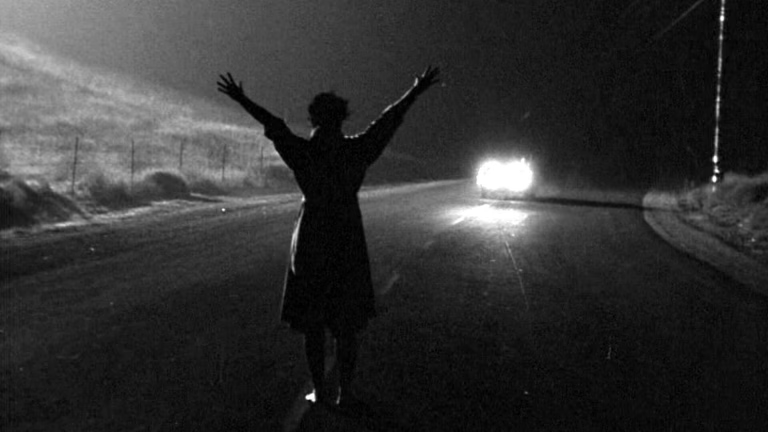
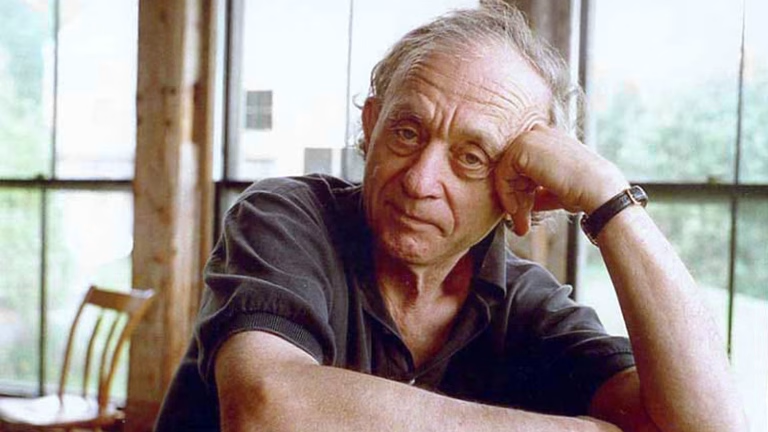
Watch this space for more on the films of “Bleak Week” later this week, but a primer: “Bleak Week” began at L.A.‘s American Cinematheque four years ago, as a film festival focused on human-scale stories set during the first week of June, a famously gray time in Los Angeles (hence the name). The festival was an immediate hit, and last year began expanding to other cities. We’re thrilled to be part of the 2026 edition, where we’ll present a full week of programming, including special 16mm film screenings with Kinonik, a partnership at SPACE Gallery, and a special afternoon with Oscar-nominated filmmaker Todd Field. This is a rare opportunity to see a vast array of canonically great international films in one tidy week, and I’m excited to introduce each screening and consider just how bleak some of these overwhelmingly human and often humane films actually are.
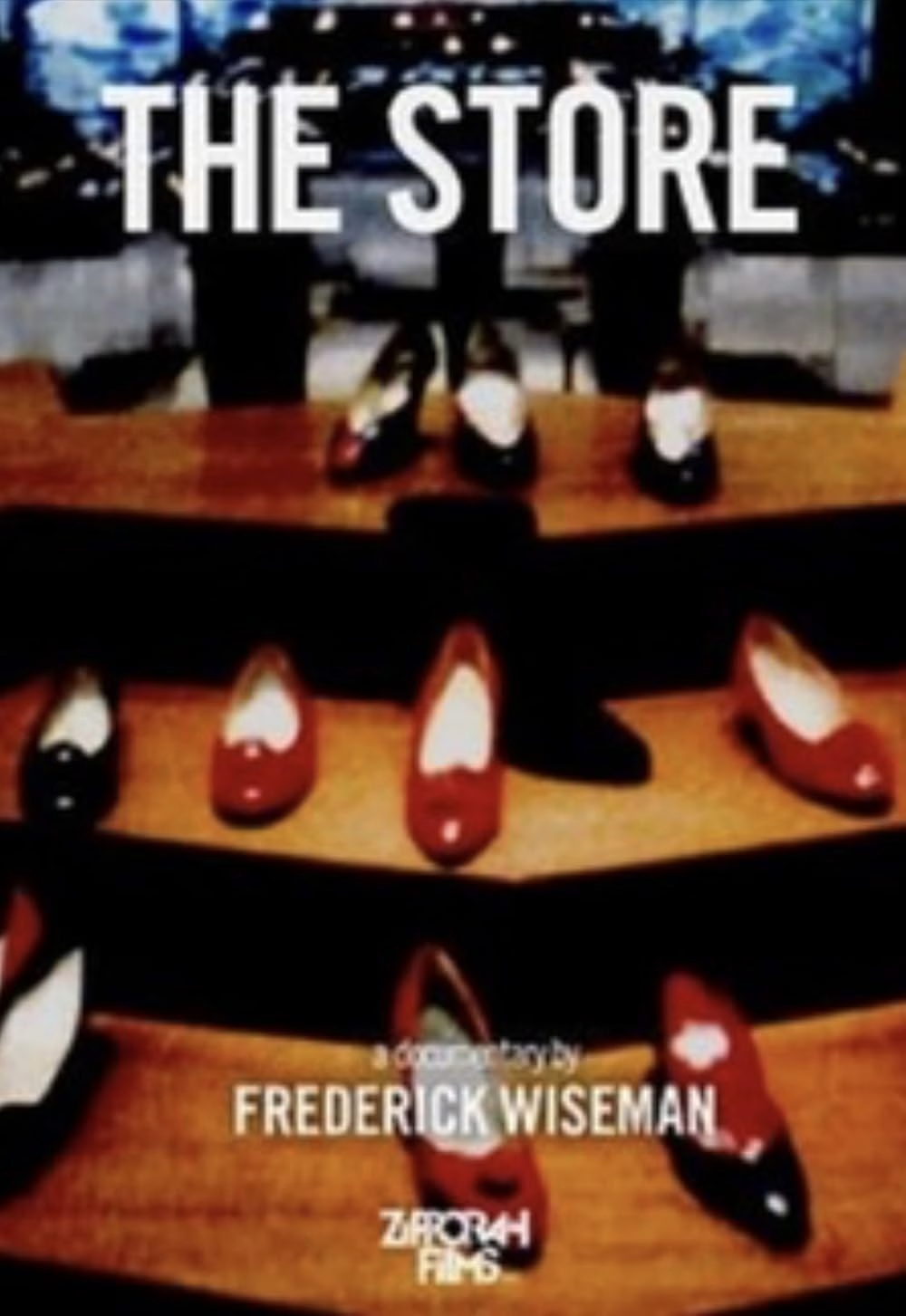
“Social Studies: A Tribute to Frederick Wiseman”: The Store (1984)
We’re into the final month of our tribute to Frederick Wiseman, and here we arrive at one of his more fascinating cultural films, The Store. This is the first film Wiseman shot in color, and it surveys the Neiman Marcus flagship store in Dallas, Texas. It’s a less gimlet-eyed view of luxury than his later Aspen, though one deeply aware of its role observing mass-market capitalism. Wiseman shrewdly shot this one over the holiday season in 1982, so the movie is filled with both gorgeous holiday scenery and shoppers in varying degrees of certainty about what they’re looking for. In addition to the action on the sales floor, the film gets some remarkable access out back, particularly in the store’s boardroom and jewelry workshop.
Amrum
Set on the titular German island near the end of World War II, Fatih Akin’s Amrum is a novel view of the German side of the conflict, as seen from a vantage point of great, windswept beauty. Nanning, a boy of twelve (played by Jasper Billerbeck), divides his time between school, farmwork, and fishing in order to help his family, with resources and food scarce after an extended conflict. His father is a Nazi officer away on the front and his mother (Laura Tonke) also supports the cause, but others in Amrum (notably a neighbor played by Diane Kruger) have opposing beliefs. The film becomes something of a sentimental education for Nanning, and it’s one executed with tremendous delicacy as practical, social, and psychological struggles mount while it becomes more clear that the war is nearing its end. Amrum is a particularly nuanced view of social unrest through the eyes of a child.

“Social Studies: A Tribute to Frederick Wiseman”: Public Housing (1997)
One of Wiseman’s most monumental and important works, Public Housing is the director’s 1997 portrait of the Ida B. Wells Homes, a vast public housing project constructed during World War II in Chicago. This is perhaps the most impressive synthesis of the director’s two prevailing modes, simultaneously exposing the unacceptable living conditions of citizens in public homes and drawing a tremendously open and warm portrait of its residents, as well as some of the employees doing their best to keep the complex running.
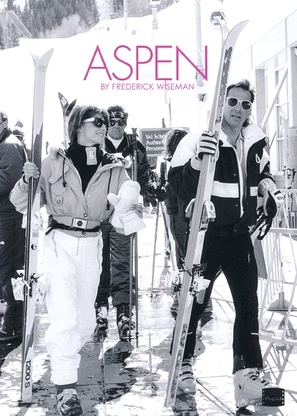
“Social Studies: A Tribute to Frederick Wiseman”: Aspen (1991)
A low-key favorite in our ongoing series “Social Studies: A Tribute to Frederick Wiseman,” Aspen surveys the Colorado skiing mecca and the emergence of its elite social culture. Once in a while you watch a Wiseman film and the director’s supposed veil of objectivity seems to drop, and as I recall (I watched this back in 2017) there are certainly elements of that here. Aspen is full of rather icky social functions and people of questionable ideals. It feels weirdly prescient: plastic surgeons and alternative medicine advocates rub elbows with artists who pivot to commercial fare and well-heeled residents. Unusually, Wiseman spends little time with the laborers of this town because he can’t seem to pull himself away from this fascinating depiction of post-Reagan American luxury. Bonus: One of the great treats of touring Wiseman’s America is the fashion and personal styling of the moment, and this movie could not deliver more on that front.
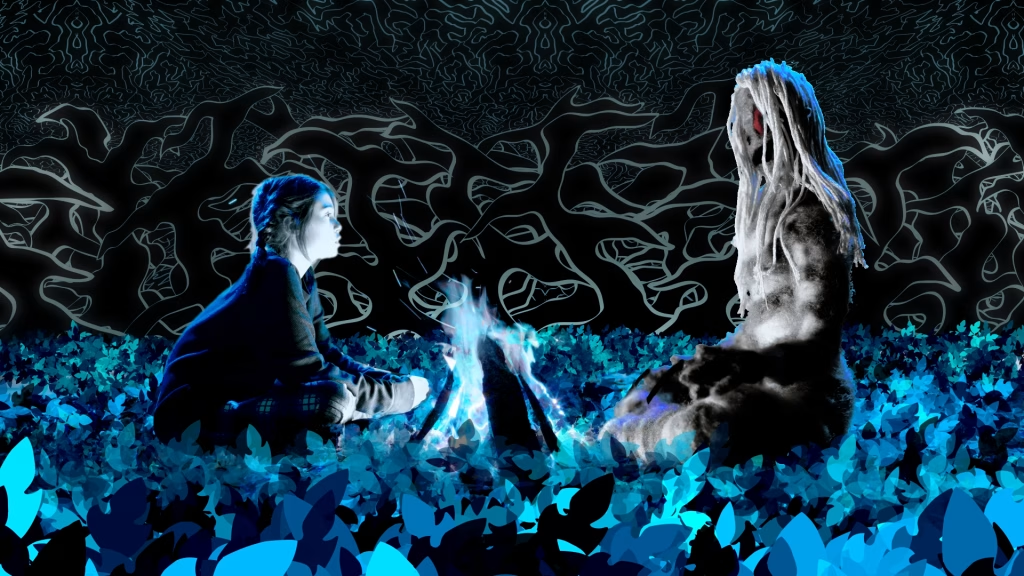
2026 Maine Mayhem Film Festival (Free Screening with filmmaker discussion)
We’re delighted to welcome back the Maine Mayhem Film Festival for a free event this Saturday. This is an annual showcase of works by students in the Communications and New Media program at Southern Maine Community College, and comes to us after sold out screenings at the Nickelodeon. This year’s screening will conclude with a discussion with some of the student filmmakers and SMCC professor Kendall Harnett.
Dry Leaf
There has never been a film like Dry Leaf, the latest from the brilliantly whimsical Georgian filmmaker Aleksandre Koberidze (What Do We See When We Look at the Sky?). A ramshackle epic with a giant heart, the film follows the efforts of Irakli (David Koberidze) to find his missing adult daughter Lisa in the Georgian countryside. Lisa, a sports photographer, has been shooting makeshift soccer pitches, and Irakli attempts to retrace her steps with the assistance of a very special assistant I’m loath to spoil. This is an utterly unique film, not only for the way its yarn unfurls but for the way it was shot: On a used Sony Ericsson phone manufactured around 2008. Koberidze’s images are heavily pixelated, and like our dinosaur-era cell phones its pixels seem to breathe as they process new information. The resulting scenes are consistently astonishing to take in over the course of three hours. Familiar tableaux (a tree, a cow in a field) pulsate in and out of abstraction. It feels, somehow, like learning how to see again, and this technique dovetails beautifully with Koberidze’s very analog story, of a man wandering through his country without a map, only the landscape and other people available to guide him.
The Stranger
“Film adaptation of Albert Camus’s bleak, existentialist 1942 masterpiece” did not initially strike me as a super appealing idea, so color me surprised that François Ozon pulls off his The Stranger with remarkable beauty and vitality. Shot in crisp, alluring black and white by Manu Dacosse, this is an adaptation that manages to be extremely faithful even as its imbued with some modern perspectives. An excellent Benjamin Voisin stars as Meursault, a Frenchman living in Algeria who murders an Arab man on a seeming whim. Meursault is defined by his indifference, but the film allows the perspectives of other characters – his lover Marie (Rebecca Marder), a neighbor played by the great Denis Lavant – to puncture his oppressive blankness. Ozon’s work here calls to mind Anthony Minghella’s The Talented Mr. Ripley: It’s extremely seductive and entertaining despite its dark, unknowable core.
Bates Film Festival
Next weekend, the Bates Film Festival takes over our auditorium for a packed weekend of screenings and special guest appearances from Friday, May 15 through Sunday, May 17. All films are free and reservations are available here. Each of these films are well worth your time, but let me run down some events with special guests, including a former Major League Baseball player!
- Opening the festivities here on Friday at 12:30 pm, Azerbaijani writer-director (and Bates grad) Ru Hasanov brings his 2020 film The Island Within, about a young chess grandmaster who flees to a remote island full of wild horses on the eve of his most important match.
- Filmmakers Sean Mewshaw, Desi Van Til, and Matthew Delamater take the stage to screen and discuss two films directed by Mewshaw: The locally-shot romantic comedy-drama Tumbledown, from 2015 and starring Rebecca Hall and Jason Sudeikis, as well as Mewshaw’s 2023 short The Diver. This event is at 5:30 pm on Friday.
- Saturday afternoon at 3:45 pm, screenwriter Michael Koryta will discuss Taylor Sheridan’s 2021 adventure Those Who Wish Me Dead, starring Angelina Jolie as a smoke jumper who comes across a young boy on the run.
- Sunday at 1 pm, Major Leaguer Bob Tewksbury will discuss his role in last year’s breakout film Eephus, the feature debut of Carson Lund. A huge hit with critics and an indie success, Eephus observes a rec-league baseball team playing their final game at their local field, which is due to be dug up to accommodate a new school. It’s a wry comedy about aging, badmouthing, and the inexorable progress of time.
- Fans of music films should look out for a couple of features: We Want the Funk!, a comprehensive survey of the genre (due to premiere on PBS later this year), which screens Saturday at 11 am; and last year’s acclaimed Köln 75, which follows a teenage concert promoter working to set up what became a legendary performance by Keith Jarrett.
“Makers at the Movies”: Mamma Mia! (2008)
As Meryl Streep supercharges the international box office with The Devil Wears Prada 2, it is an auspicious time to bring back our “Makers at the Movies” series for a screening of Phyllida Lloyd’s 2008 blockbuster jukebox musical, Mamma Mia! As a reminder, “Makers at the Movies” is a crafting series presented with Olde School Fiber & Craft and Handiwork. We’ll bring the movie and leave the lights up a bit so you can work on your knitting, crochet, drawing, or other craft project during the film.
Mamma Mia! was famously released as counterprogramming to The Dark Knight in July of 2008 – remember counterprogramming? – and became a massive hit, based on the popularity of both ABBA’s music (performed in varying degrees of quality by a game ensemble cast) and the 1999 musical. Its absurd plot (young bride-to-be invites three of her mother’s exes to the wedding, in hopes of finding out which one is her father) and glistening setting gels perfectly with the unremittingly sunny source material.
Women Laughing (Encore Screening)
After a sold-out screening featuring filmmaker Liza Donnelly and Heather Cox Richardson at the University of Southern Maine, we’re delighted to bring Donnelly’s medium-length film Women Laughing to the PMA for an encore screening. In the film, Donnelly assembles a conclave of the New Yorker’s female cartoonists, from longstanding magazine fixtures Roz Chast and Emily Flake to newer voices like Liana Finck and Sarah Akinterinwa. Along with discussing the present-day challenges and triumphs of getting your work to this esteemed magazine, the film also digs into the broader history of women cartoonists in the publication. For a nice companion piece to Donnelly’s film, I also recommend Leah Wolchok’s very good 2015 documentary Very Semi-Serious, another view of the New Yorker’s cartoon department which I remember for its compelling chronicle of Finck at the very beginning of her career.
Blue Heron
I’m pretty sure that Blue Heron, Sophy Romvari’s remarkable debut feature and the year’s best-reviewed (and best) movie, is the first film I’ve watched twice before we’ve even shown it here at the PMA. I’ll be seated again this weekend. Blue Heron follows a family in late 1990s Canada, after their move to Vancouver Island. Seen mostly from the perspective of eight-year-old Sasha (Eylul Guven), the film exquisitely captures the dynamics of a summer free from school in a new place: days spent with her mother (Iringó Réti) and siblings exploring surrounding parks and beaches, first encounters with future friends, sweet lulls between activities. This idyll – which has a fractured quality that evokes our own memories — is prone to disruptions by Sasha’s teenage brother, Jeremy (Edik Beddoes), who demonstrates quietly oppositional and sometimes dangerous behavior.
Blue Heron is an autobiographical film, expanding on subject matter Romvari has explored in earlier shorts. I can’t think of a movie that has so tenderly depicted a family living through a mental health crisis, and Romvari is keen to align the film with Sasha’s perspective: nonjudgmental, living through an experience she doesn’t fully realize is unusual and perhaps impossible to resolve. It yields a rare strain of intimacy, even as it’s faithful to the experience of being a child (scenes are full of half-overheard conversations and shots from low or limited perspectives). Without saying too much, the second half of the film offers a surprising shift in perspective. The move is bold but entirely in line with Romvari’s efforts to explore her past with the utmost sensitivity. Blue Heron is formally and psychologically complex, but throughout it conveys an overwhelming emotional clarity. (This is to say: I cried a lot.) As The Ringer’s Sean Fennessey aptly put it: “Only movies can do this.”
“Social Studies: A Tribute to Frederick Wiseman”: Menus-Plaisirs Les Troisgros (2023)
An exquisite four-hour ramble through the operations of a Michelin-feted, family-owned restaurant mini-empire, Menus-Plaisirs Les Troisgros is Wiseman’s final film and a blissful swan song. Set largely at La Maison Troisgros, a hotel and restaurant located outside of Lyon, the documentary is stuffed with sensory pleasures but also pays keen attention to the operational rhythms and class stratification of such an exalted place. For me, one of the great joys of watching a Wiseman film is that moment when his vast panorama snaps into place and you realize you’re watching a perfectly judged final scene that ties the entire project together. I remember welling up when I got the sense that Menus-Plaisirs was coming to an end; it’s one of Wiseman’s best and most touching finales.
Screening Times and Tickets:
- Screenings April 25-May 2
Maine Jewish Film Festival
The main event in our auditorium over the next couple of weeks is the Maine Jewish Film Festival, who will host ten screenings here in addition to plenty more across the state. As always, the festival presents a wide range of films from around the world from a variety of perspectives. We’ve received requests to show a number of the films MJFF will be screening this year, so you’d be wise to consult the festival’s website for a full rundown of their offerings; screenings held in our auditorium are listed in the Films section of our website as well. I’m particularly keen to see Maintenance Artist, about the New York City Sanitation Department’s artist-in-residence, as well as Holding Liat and Heightened Scrutiny.
Screening Times and Tickets:
- Friday, April 24 at 6 p.m.
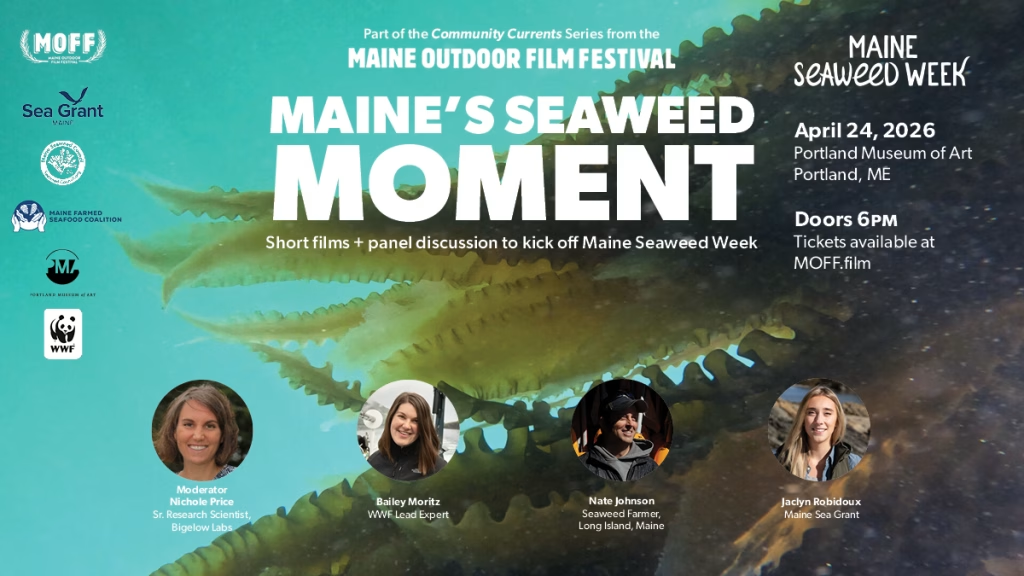
“Maine’s Seaweed Moment” (presented by Maine Outdoor Film Festival)
Maine Seaweed Week kicks off with an event hosted by our friends at the Maine Outdoor Film Festival. The evening will feature the Maine Premiere of Maine’s Seaweed Moment, a new short from No Umbrella Media, as well as some additional films. After this short film showcase, an esteemed panel of scientists and those involved directly in the seaweed industry will discuss seaweed’s potential for the economy and climate gains. This is a pay-what-you-can event; tickets and more information are available here.
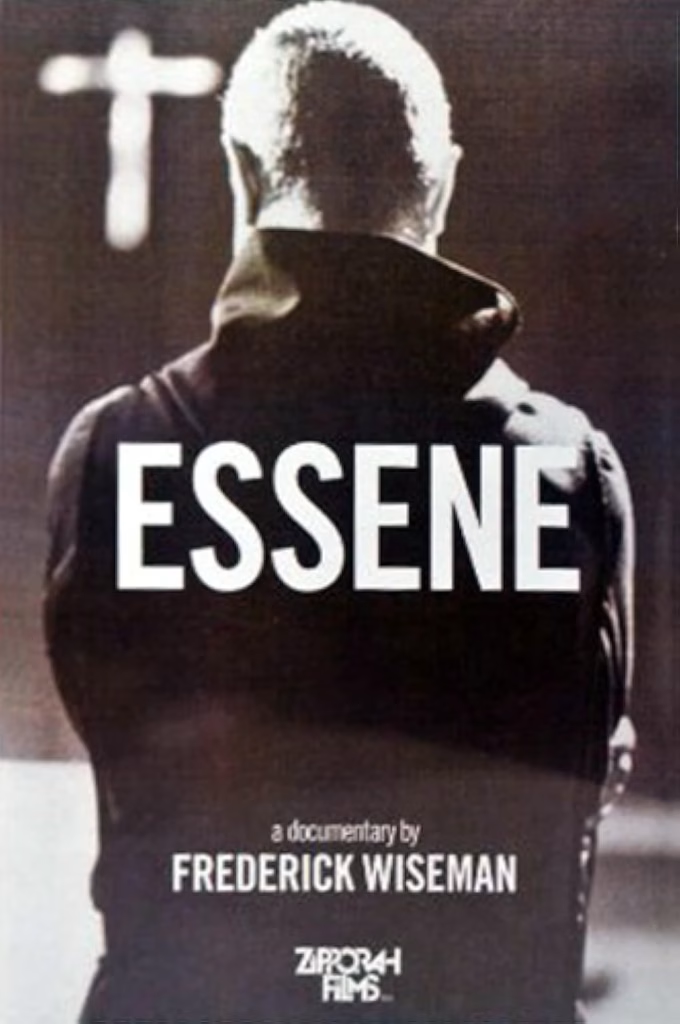
“Social Studies: A Tribute to Frederick Wiseman”: Essene (1972)
Over the next two months, we’ll pay tribute to the late, great Frederick Wiseman, whose inimitable documentary work has been a stalwart of film programming at the PMA over the years. (I fondly recall seeing his great 2010 Boxing Gym here.) “Social Studies: A Tribute to Frederick Wiseman” kicks off with a Friday matinee screening of Essene, an underseen gem of his catalog. (Like all of the classics in the series, this has recently been restored in 4K.) Shot at an Anglican Benedictine monastery in Michigan, the film observes the rituals – both sacred and mundane – of monastic life. Wiseman discovers a wonderful array of characters here, from earnest seekers whose selfish aims are in fundamental conflict with the goals of the church to a particularly touchy old hand with rigid standards. Essene spends equal time with matters exultant and the petty, underscoring some basic challenges of devotion and communion.
Miroirs No. 3
I bow to few in my admiration of the German director Christian Petzold. A king of the efficient, resonant 90-minute melodrama, Petzold’s work is a wide range of variations on a theme, exploring modern identity in the shadow of environmental catastrophe (Afire), war (Phoenix, the extraordinary Transit), or a globalized economy (Jerichow). Vertigo is always a reference point for Petzold, and remains so in fascinatingly oblique ways in his new Miroirs No. 3, about a woman (Paula Beer) who loses her boyfriend in a car accident and recovers in a rural home. Beer’s Laura is taken in by Betty (Barbara Auer), who lives apart from her husband and son, who are nonetheless always nearby. Despite her tragedy, Laura slips into her new circumstance with an odd sort of comfort, which Petzold exploits for maximum psychological intrigue, asking whether Laura’s respite may be an appropriate new life for her, or perhaps a metaphysically dizzying return to a previous life. I highly recommend looking up some interviews with Petzold. He’s one of the most intelligent and frank (yet amiable) speakers about film around.
Yes
The latest film from the stylish and reliably incendiary Israeli filmmaker Nadav Lapid is the director’s first release since his country’s war with Gaza, and thus his first to tackle the conflict head-on. That said, Lapid is no stranger to national and self-analysis, having made a series of bold, anguished, and acclaimed films such as Synonyms and Ahed’s Knee. Yes stars Ariel Bronz as Y., a jazz musician who along with his wife Yasmin (Erfat Dor) resolves to say yes to everything in hopes of achieving a higher station. In post-October 7 Israel, this means playing along with the nation’s political and military elite, who task them with creating a new national anthem. This fiery premise is accompanied by a whirlwind of stylistic bravado that underscores the chaos of this social moment, ping-ponging between hectic parties and meetings before the film later enters a more subdued space. It’s a film that strives to encompass all of Lapid’s complex feelings about his homeland. (For some additional context, I recommend this article from yesterday’s New York Times.)
Schindler Space Architect (with filmmaker Valentina Ganeva)
First up this week is a very special event, co-presented with Architalx. Filmmaker Valentina Ganeva joins us to screen her documentary Schindler Space Architect, about the Austria-born designer R.M. Schindler, a pioneer in his field who designed homes with a lifestyle of indoor-outdoor living in mind. Featuring narration by Meryl Streep, the late Udo Kier, and Maine resident Xander Berkeley, the film explores Schindler’s relationship with Frank Lloyd Wright, among others, as well as his wider oeuvre. Before the film, feel free to join us for an informal reception on the Lower Ground Floor from 5–6 pm. After the film, Architalx President Andrew Ashey will chat with the filmmaker.
Soul (2020) (Free Screening)
As a little school vacation week treat, we’re offering a free screening of Pete Docter’s wonderful Soul. Along with Turning Red, this is one of the best recent Pixar offerings, and an unfortunate casualty of the theatrical experience due to the pandemic. Before the film, we’ll have a free drop-in artmaking session in the Great Hall where families can create their own abstract window collages, a fun activity that pairs with both the film and our ongoing Ming Smith exhibition. That will run from noon‑2 pm, when you can hop into the auditorium for Soul, about a lifelong musician and middle-school teacher who tumbles into a sort of reverse purgatory, a land where people become who they’ll be when they arrive on Earth.
The Day Iceland Stood Still
After a sold out screening last month, we’re happy to give you all another opportunity to see Pamela Hogan’s rousing documentary, The Day Iceland Stood Still, which was greeted with a standing ovation in March. The film tells the story of a grassroots feminist political movement that materialized just over fifty years ago, where nearly all of the nation’s women took the day off from work in protest of wage inequality and unfair labor conditions. Told by many of the participants themselves, The Day Iceland Stood Still is a fleet and inspiring portrait of organizing and communion.
Days and Nights in the Forest (1970) (New 4K Restoration)
Once in a great while I need to save myself a little treat to watch in our theater, so I’ve yet to see the great Satyajit Ray’s 1970 film Days and Nights in the Forest, which we’ll be screening in a new 4K scan with an introduction by Wes Anderson. (This restoration was a passion project for the filmmaker.) The film follows a group of four well-off men who embark on a vacation to an area of mostly Indigenous residents. Privilege plays into their ensuing misadventures, which include rabblerousing and encounters with women of their caste. You can safely assume it’s all rendered with Ray’s remarkable sense of beauty and realism.
Alpha
The French filmmaker Julia Ducournau has made a name for herself over the last decade with a couple of films most frequently described as works of body horror: 2016’s Raw and 2021’s Palme d’Or-winning Titane. Ducournau’s new Alpha lacks the shock premise of either of those films, but it carries over the director’s interest in stories of young people confronting trauma and discovering the realities of the adult world. An allegory for the AIDS crisis, the film takes place in an ambiguously dystopian world where a virus turns its victims into fragile statues. Young teenager Alpha (Mélissa Boros) receives a stick-and-poke tattoo that becomes infected, and lives in fear that she has caught the virus, in no small part because of her proximity to her nurse mother (Golshifteh Farahani, who is excellent and who you may recognize from Jim Jarmusch’s great Paterson) and uncle Amin, played by Tahar Rahim. What ensues is a complex and multifaceted domestic epic, spanning two timelines and rich with ideas about adolescence, fear, tradition, and addiction.
BLKNWS: Terms & Conditions
In collaboration with Indigo Arts Alliance and SPACE Gallery, the Maine premiere of artist Kahlil Joseph’s documentary BLKNWS: Terms & Conditions begins screening on April 3. This project began its life as an installation at the 2019 Venice Biennale, and has since expanded into a feature-length celebration of black consciousness. Joseph first grabbed my attention as one of the directors of Beyoncé’s 2016 visual album Lemonade, but before this he worked with legendary director Terrence Malick and has also collaborated with Kendrick Lamar, Sampha, FKA Twigs, and many others.
Joseph’s multidisciplinary approach is evident in BLKNWS, which consists of a few strands: satirical news broadcasts; a collage of video and snippets of contemporary life, social media, and history; and an narrative piece that ties everything together with a somewhat Godardian spirit. The result is playful and infectious, unspooling like an album or DJ set that reaches towards a totality of black experience and how it is filtered through the media channels of the day.
Salt Marsh (with artist Mitchell Rasor)
Also on Sunday, we’re delighted to be joined by artist Mitchell Rasor and filmmaker Tom Bell, who will be presenting their new Maine short Salt Marsh alongside a discussion and artist talk. Rasor’s work was recently featured in the Portland Press Herald, and we’re lucky to be able to be able to dive in to its unique beauty and qualities this weekend. Salt Marsh was directed by Bell, who recently helmed An Extraordinary Place, a short documentary about WMPG, and the film was scored (remarkably well, needless to say) by Lee Ranaldo of Sonic Youth. Along with a discussion, this event will feature an artist talk by Rasor.
Little Shop of Horrors (1986)
Films will be a bit quiet this weekend as Art in Bloom takes center stage, but we come roaring back on Sunday with a pair of special, thematically appropriate screenings. First up is Frank Oz’s enduringly strange and wonderful Little Shop of Horrors, from 1986. Rick Moranis stars as Seymour, the flower shop employee pining for a co-worker (Ellen Greene) and attending to a remarkable but dangerous plant that saves the shop as it grows into something much larger than anyone intended. (There are plenty of great supporting turns by ‘80s comedy stalwarts to look out for as well.) This film conjures a lot of “they don’t make ‘em like they used to” feelings for me, with its comfort mixing sunny, irresistible tunes and a dark, often cynical and gritty atmosphere.
Sirât
At long last, I’m excited to bring Oliver Laxe’s bold, Oscar-nominated Sirāt to our screen. The French-Spanish filmmaker, probably (until now) best known for 2016’s Mimosas, deftly mixes genre conventions with a heavy dose of existentialism, which Sirāt deploys in a shocking manner. The film follows father Luis (Sergi López) and his son Esteban (Bruno Núñez) as they search for Luis’s daughter, who is believed to be at a desert rave in Morocco. They receive the assistance of a reluctant group of traveling ravers, a remarkable ensemble that Laxe discovered during his research for the film. Their voyage through the desert takes place in the backdrop of an elusive but major armed conflict, and it transpires like a meditative Sorcerer, with moments of incredible tension. I’ll caution that Sirāt will surely upset some audience members and some of you may want to do additional research. (I gasped numerous times when I watched the film at a festival this fall.) I think one of the reasons Sirāt has caught on to the degree that it has – it is already a major favorite among filmmakers and actors — is its debt to Sorcerer and other 1970s films, marked primarily by an eagerness to delve into the existential and a refusal to qualify itself. It’s a formidable film that, in a nice piece of Oscar trivia, boasts the first all-female sound crew to be nominated for an Academy Award.
The President’s Cake
Winner of an Audience Award and the Caméra d’Or at last year’s Cannes Film Festival, The President’s Cake is the massively impressive debut feature of Iraqi writer/director Hasan Hadi. Set in a period of economic sanctions after Iraq’s invasion of Kuwait in the early 1990s, the film is a modern piece of neorealism. At school, nine-year-old Lamia (Baneen Ahmad Nayyef) “wins” a lottery requiring her to make a birthday cake honoring Saddam Hussein’s birthday. Ingredients and resources are scarce in her home, so she and grandmother Bibi (Waheed Thabet Khreibat) head into the city to fill out the recipe. Their journey takes more than a few unexpected turns, which Hadi captures with striking photography and an easy way with his actors, painting a portrait of youth brushing up against the social and political realities of their era.
The Voice of Hind Rajab (Encore screenings)
By popular demand, we’re offering a couple more opportunities to see Kaouther Ben Hania’s Best International Feature-nominated The Voice of Hind Rajab.Like Ben Hania’s other works (Four Daughters), this is an unusual film in form – I’d call it a docudrama based on real events, which utilizes both actors and the real voice of its title character, paced to the beat of a thriller. The film received what is said to be the longest film festival ovation ever upon its premiere at Venice last year. It follows the work of Red Crescent responders as they attempt to locate and send an ambulance to five-year-old Hind, whose family has come under attack while traveling by car in Gaza.
2026 Oscar Nominated Shorts
This year’s three Oscar Nominated Shorts packages–honoring the best in Live Action, Documentary, and Animated shorts–begin screening on February 20, and will continue running for three weeks. I’m still working my way through this year’s crop, but I had a good evening with the Documentary shorts, which are almost uniformly solid and topical. The program begins with the sole short that doesn’t directly engage politics, Alison McAlpine’s Perfectly a Strangeness, a visually striking look at a trio of donkeys who happen upon an abandoned astronomical observatory. Best in class among the other films for me were probably two shorts: All the Empty Rooms, by Joshua Seftel, chronicles an effort by journalist Steve Hartman and photographer Lou Bopp to transcend the numbing effect of how school shootings are discussed in the media; The Devil is Busy, by Geeta Gandbhir and Christalyn Hampton, is set at an Atlanta healthcare clinic for women, and primarily focuses on the work of the clinic’s head of security, who must respect the rights of protestors while providing comfort and safety to incoming patients. (Co-director Gandbhir, it should be noted, is also nominated for her feature documentary The Perfect Neighbor, a very interesting spin on the true crime doc that is available to watch on Netflix.)
The Live Action category – often a rather grueling batch – is quite a bit lighter than it has been in recent years, with only one film (Butcher’s Stain) occupying the “tough story framed by contemporary political concerns” bucket. The other four films are, in one way or another, comedies. My favorite is maybe the opening film, The Singers, a really well-cast and handsomely assembled short set in a dive bar; it has the look of something by a hip, talented young filmmaker yet goes to very earnest places. Other crowd pleasers abound in A Friend of Dorothy and Jane Austen’s Period Drama, while the longest film on offer (Two People Exchanging Saliva) presents a surprisingly ambitious sci-fi premise inside an aesthetic that is deliberately “’90s French black-and-white perfume commercial.” It’s pretty cool.
If you’re wavering, I’d probably opt against taking young children to this year’s Animated shorts batch, the first three of which have been deemed appropriate for all audiences. Outside of Forevergreen, they have a generally mature tenor. The two most simply drawn shorts in this group were my favorites: opening short The Three Sisters, about a trio of siblings that live in separate, adjacent homes on a tiny island who are visited by a strapping sailor. Equally charming is Retirement Plan, narrated by the actor Domhnall Gleason, who recites the hopes and dreams of a man who has the rest of his life ahead of him. The most visually striking film of the batch is Papillon (Butterfly), a watercolor wonder that creatively portrays the life of Alfred Nakache, a Jewish French swimmer who competed at the 1936 Berlin Olympics.
The Day Iceland Stood Still (Free screening introduced by director Pamela Hogan)
For International Women’s Day, we’re pleased to show Pamela Hogan’s documentary The Day Iceland Stood Still, and by a happy coincidence we’re even more pleased that Hogan herself will be in attendance for the screening! She’ll deliver an introduction before the film, and will be available after the film to chat outside of the auditorium. The Day Iceland Stood Still tells the story of a grassroots feminist political movement that materialized just over fifty years ago, where nearly all of the nation’s women took the day off from work in protest of wage inequality and unfair labor conditions. Told by many of the participants themselves, the film is a fleet and inspiring portrait of organizing and communion.
Unless Something Goes Terribly Wrong (with panel discussion)
The local documentary sensation Unless Something Goes Terribly Wrong returns for a special screening and panel discussion organized by the Greater Portland Council of Governors. Representatives from that group, Portland Water District, and filmmaker Alex Wolf Lewis will be on hand to discuss some of the quality of life and infrastructural issues raised by this extremely winning film.
Come See Me in the Good Light
We’re very fortunate to be one of very few theaters screening the Oscar-nominated documentary Come See Me in the Good Light. Ryan White’s film follows the poet Andrea Gibson and their partner Megan Falley through Gibson’s terminal cancer diagnosis. It’s a film that insists on life and living. Gibson, the Colorado poet laureate who passed away last year, grew up in Maine and discovered poetry after moving to Colorado in the late 1990s, eventually becoming a renowned and beloved performer. White’s film is framed around Gibson’s hope to perform a final show as her health prospects fluctuate, but most of our time is spent with Gibson, Falley, and a rotating cast of visitors,in scenes teeming with humor and intimacy. It’s an inspiring portrait.
Mr. Nobody Against Putin
Pasha Talankin has what seems like one of the few jobs suiting a creative type in his rural Russian town. He’s a teacher tasked with filming all school events at his primary school, with a large office where like-minded students can gather. But his job takes on a new angle after Russian invades Ukraine, and Talankin becomes something of a forced propagandist, recording highly patriotic new ceremonies and curricula. To the Russian government, this footage serves as proof that Talankin and his teachers are following orders.
With David Borenstein, Talankin is co-director of Mr. Nobody Against Putin, one of this year’s nominees for Best Documentary Feature at the Oscars. As you may expect, Talankin’s anguish over his new role and his country’s actions prompt him to take drastic actions. This film was completed after he left his job and fled the country. What he’s captured is remarkable, and resonant, a story about how quickly politics can fundamentally alter your existence, both socially and professionally. Borenstein and Talankin convey this with an intimate and often light touch; the film is perhaps as enjoyable as a story like this can be.
The Love That Remains
The Icelandic filmmaker Hlynur Pálmason had something of an international breakthrough with 2022’s Godland, and ambitious and tonally complex portrait of a young priest sent on mission to rural Iceland in the 19th century. I’m an even bigger fan of Pálmason’s new film, The Love That Remains, a totally gorgeous and uniquely mounted chronicle of everyday domestic concerns. Winner of the Palm Dog at the 2025 Cannes Film Festival – this is a critics’ award honoring the best canine performance at the festival, an honor well deserved in this case – the film stars Saga Garðarsdóttir as Anna, a struggling artist with three children (two played by Pálmason’s own kids). Her marriage to industrial fisherman Magnús (Sverrir Páll Guðnason) appears to be on the outs, though this is just one of a number of mysteries Pálmason’s tantalizing sense of scene-setting and framing leaves a bit unresolved.
Instead, Pálmason elects to largely highlight the mundane as deeper feelings roil under the surface. Despite its very unique tone, the film is surprisingly (pardon the bland word) relatable. Hikes are hiked, tweenage boys behave strangely, children gently try to figure out if their normal family is indeed as normal as they believe it to be. It’s lovely stuff, all gorgeously lensed by Pálmason himself.
Arco
I’m delighted that Ugo Bienvenu’s animated film, Arco, received an Oscar nomination for Best Animated Feature. This is a very Hayao Miyazaki-adjacent fable about a 10-year-old boy from the distant future who disobeys his parents wishes and travels back in time to 2075. There, he finds a slightly more recognizable world and a new best friend, Iris. In classic children’s story fashion, Iris’s home is essentially absent of parents (they appear in hologram form), but she and her younger sibling are looked after by a really cool robot housekeeper, Mikki. Together, Mikki, Arco, and Iris face an environmental calamity they may be able to prevent. The film is rated PG for some peril, but on the whole it’s a lovely film, featuring the voices of Natalie Portman, Will Ferrell, Flea (!), and others.
Resurrection
For American audiences, the Chinese filmmaker Bi Gan is perhaps just another brilliant young guy who puts out a dazzling movie every few years. I remain astonished to be reminded that his career in China is quite different. His previous film, Long Day’s Journey Into Night, was (erroneously!) marketed as a New Year’s date movie and topped the Chinese box office on its opening weekend. Somehow, his new Resurrection accomplished the same feat. This must be a boon to the budgets of his films, because Resurrection is quite a remarkable production: a journey through dreams and cinema unfolding over five chapters and a century of cinematic modes and styles, from the silent era to an epic, 30+ minute single-shot wonder.
For me, after one viewing (I’m eagerly awaiting another), this is a movie to experience rather than fully comprehend, though I was astounded by Justin Chang’s review in the New Yorker, which seems to have the movie pinned down quite nicely and is probably worth reading before you head into the theater. Resurrection transpires in a space that’s both quite Lynchian and very earnest, a sentimental love letter to film that explores its byways and crevices. There is simply nothing like it.
“Reflections”: Wisdom of Happiness
Thursday, January 29 at 3:30 p.m.
For those of you entering the new year seeking grounding and intention, Wisdom of Happiness ought to be just the ticket for you. The film, directed by Barbara Miller, Philip Delaquis, and Manuel Bauer, concludes our “Reflections” series and finds the Dalai Lama addressing the viewer about the challenges of modern stressors as we seek inner peace and global justice.
Magellan
- Friday, January 30 at 2 p.m.
- Saturday, January 31 at 12 p.m.
- Sunday, February 1 at 3 p.m.
- Thursday, February 5 at 3 p.m.
Balancing a hypnotic, sumptuous tone with a righteous post-colonial perspective, Magellan is the first film by the Filipino director Lav Diaz to receive a relatively wide release. Gael García Bernal stars as the explorer Ferdinand Magellan, in what is less a traditional biopic than a chronicle of the ravages of conquest. This is evident in the film’s striking opening, where an Indigenous woman in historic Malacca encounters a white man. You may be forgiven for briefly thinking this is a horror movie. Bernal is no hero as Magellan, merely a man with an iron determination that feels more myopic with the passage of time.
It’s thrilling to see Diaz working in such a grand and relatively accessible format. The filmmaker is probably one of the most widely known directors whose work goes very little seen. This is a matter of duration: Diaz’s films often run past the four- or five- hour mark, hindering their ability to receive stateside distribution. (The last one I saw was 2013’s Norte, the End of History, a terrific riff on Crime & Punishment.) He is, nonetheless, one of the progenitors of what is called “slow cinema.” Magellan marks a significant leveling up of the resources he has at hand. Here, he works with the astonishingly talented cinematographer Artur Tort: a regular collaborator with Albert Serra, Tort’s last two films (Pacifiction and Afternoons of Solitude) are some of the most beautiful I’ve seen anytime recently. So is Magellan, a 4:3 wonder filled with unreal colors and a holy approach towards the natural world.
The Voice of Hind Rajab
The last film we screened by the Tunisian director Kaouther Ben Hania, 2023’s Four Daughters, later became the recipient of a surprise Oscar nomination for Best Documentary Feature. As I am writing this, her new film, The Voice of Hind Rajab, seems likely to follow the same trajectory into a Best International Feature nomination. (Update: It did!) Hind Rajab is an unusual film in form – I’d call it a docudrama based on real events, which utilizes both actors and the real voice of its title character and is paced to the beat of a thriller. Ben Hania’s film received what is said to be the longest film festival ovation ever upon its premiere at Venice last year. It follows the work of Red Crescent responders as they attempt to locate and send an ambulance to five-year-old Hind, whose family has come under attack while traveling by car in Gaza.
Arco
I am sitting here waiting to find out if Ugo Bienvenu’s lovely animated film, Arco, also received an Oscar nomination for Best Animated Feature (update: TK). Regardless, it’s well worth your time, a very Hayao Miyazaki-adjacent fable about a 10-year-old boy from the distant future who disobeys his parents wishes and travels back in time to 2075. There, he finds a slightly more recognizable world and a new best friend, Iris. In classic children’s story fashion, Iris’s home is essentially absent of parents (they appear in hologram form), but she and her younger sibling are looked after by a really cool robot housekeeper, Mikki. Together, Mikki, Arco, and Iris face an environmental calamity they may be able to prevent. The film is rated PG for some peril, but on the whole it’s a lovely film, featuring the voices of Natalie Portman, Will Ferrell, Flea (!), and others.
“Makers at the Movies”: You’ve Got Mail (1998)
Last but certainly not least, we’re excited to try something new in our theater. “Makers at the Movies” is an opportunity for local crafters to come enjoy a film with their peers while working on a project. We’ll keep the lights partially dimmed to allow you to work on your lap crafts, be they knits, crochets, or drawings. (We just ask that you refrain from bringing glitter or wet materials such as ink, paint, or glue.) This screening is presented collaboration with Olde School Fiber & Craft and Handiwork, and we’re excited to see if this is something that you’ll be interested in attending on a more regular basis. We’ll kick this off with a familiar classic, Norah Ephron’s 1998 rom-com You’ve Got Mail, starring a grinchy Tom Hanks and a radiant Meg Ryan in a faraway time where Barnes & Noble was considered a corporate villain.
After a couple of sold-out screenings presented in partnership with Points North, we’re thrilled to offer some additional screenings of Alex Wolf Lewis and Kaitlyn Schwalje’s Unless Something Goes Terribly Wrong, a great documentary about the employees of the Portland Water District, whose work keeps us safe in myriad ways. Tickets have been continuing to move steadily, so it seems likely we’ll give the film another screening in February.
“Reflections”: Memoria (2021)
One of the first films I programmed in my role here at PMA Films HQ (and still one of the best of our young decade), Apichatpong Weerasethakul’s Memoria continues our series “Reflections” this weekend. Tilda Swinton stars as Jessica, a visitor to Bogotá who is suddenly plagued by a mysterious sensory illness, a loud sound that only she can hear. Her journey to locate its source begins as a pragmatic exercise, but gradually takes on mysterious political and cosmic dimensions. Weerasethakul, a Thai filmmaker and artist, is one of the giants of so-called “slow cinema,” best known for this and his Palme d’Or-winning Uncle Boonmee Who Can Recall His Past Lives. Each of his films find a unique tension between modern concerns and questions that are more eternal or existential, landing on occurrences that defy explanation and learning to make piece with them. All of his films are truly special, but to witness an actress like Swinton so effortlessly inhabit the unique climate he creates is really something.
Blue Moon
Richard Linklater’s film imagines an evening where legendary songwriter Lorenz Hart, a collaborator with composer Richard Rodgers, attends the opening night party for Rodgers’ first partnership with Oscar Hammerstein II, Oklahoma! Even if you’re scantly familiar with these players, you know how this story ends. The brilliance of Ethan Hawke’s performance here is that you sense that the diminuitive Hart knows a chapter in his life has ended, too. He simply can’t help but go down swinging, full of vinegar, pride, and desperation.
I caught Blue Moon a couple of months ago, in an otherwise empty theater on a weeknight, and found myself both massively entertained and quite emotional by the time it ended. Linklater accomplishes something pretty magical, orchestrating a tour through a very specific sliver of New York social life where time seems to expand and contract like an accordion. There are beautiful performances in the margins, particularly from Patrick Kennedy as E. B. White and Andrew Scott as Rodgers, but this is Hawke’s show: he is maddening, whip-smart, and utterly free of vanity.
Father Mother Sister Brother
The first film in six years from an icon of American independent cinema, Jim Jarmusch’s Father Mother Sister Brother garnered the top prize at this year’s Venice Film Festival and is headlined by an amazing cast, including Tom Waits, Cate Blanchett, Vicky Krieps, Charlotte Rampling, and Adam Driver. A triptych of three thematically connected shorts, the film explores a variety of family dynamics, namely the half-truths we tell one another and the quiet boundaries we must overcome to connect. The result is deceptively light, an engaging, Ozuesque comedy with twinges of melancholy and a keen sense of how the passage of time reveals the ways in which we all change, as well as the ways we remain exactly the same.
La Grazia
The Italian arthouse stalwart Paolo Sorrentino reunites with actor Toni Servillo (The Great Beauty) in La Grazia, a political drama so sane and centered it can’t help but feel refreshing. Servillo (who won the Volpi Cup for Best Actor at the Venice Film Festival for this role) plays a widowed Italian president in his final months of office, simultaneously mulling over controversial euthanasia legislation and discovering revelations about his past. I should admit this is the first Sorrentino I’ve seen, and I’m glad it was. Servillo’s commanding performance of deliberation dictates the movie’s energy, but Sorrentino deftly sprinkles moments of surrealism throughout.
The Secret Agent
Quickly climbing into the Best Picture rankings of most Oscar pundits, Kleber Mendonça Filho’s The Secret Agent arrives to the PMA on a wave of critical adulation, particularly for Wagner Moura’s exquisite lead performance as Armando, a former professor attempting to find a landing place in the midst of Brazil’s repressive military dictatorship of the 1970s. This is the most high-profile film yet from Mendonça Filho, who has been a fixture of arthouse circles for the past decade or so (see his Aquarius, Bacarau, or Neighboring Sounds, which range from really good to pretty great).
The Secret Agent is a tough film to describe: It’s a tale of espionage, a story about a group of dissidents who believe they’ve found a safe haven, sometimes even a gleefully poppy action film. Mostly, it is invigoratingly curious, unafraid to go on entertaining diversions from its central plot and get into the theatrical release of Jaws or other urban legends of the moment. You sense that Mendonça Filho is out to illustrate how the politics of the moment infected public life and culture: Suddenly the fears we faced in the movie theater felt much more worth confronting. I’m really excited to watch it again, and if you’ve got the time, I highly recommend checking out Mendonça Filho’s recent documentary, Pictures of Ghosts, ahead of time.
After a couple of sold-out screenings presented in partnership with Points North, we’re thrilled to offer some additional screenings of Alex Wolf Lewis and Kaitlyn Schwalje’s Unless Something Goes Terribly Wrong, a great documentary about the employees of the Portland Water District, whose work keeps us safe in myriad ways. Tickets for these holiday screenings are selling briskly, so I’d recommend picking one up early if you plan to attend. I’ve added one additional showtime to our calendar in January, and we’ll make space for more in February if demand persists!
Safe (1995) (30th Anniversary 4K Restoration)
I’m hard-pressed to think of a more vital and prescient American film from the 1990s than Todd Haynes’s Safe, which we’ll be showing in a brand-new 4K restoration this weekend. (We are absolutely delighted that actor Xander Berkeley, a supporting character in the film, will be on hand to introduce it on Sunday, December 21 at noon.) The film stars Julianne Moore as Carol White, a wealthy Los Angeles housewife who is suddenly stricken with a mysterious “environmental illness.” Initially considered to be a metaphor for the AIDS crisis, Haynes’ film now seems to encompass everything from wellness and influencer culture to fears of an interconnected, globalized world. Whatever it means, Safe remains a masterpiece, a tragic character study infused with elements of horror filmmaking and a striking well of empathy. Haynes remains one of our most smartest filmmakers, and this is the film where his ideas and his emotional story are most perfectly in sync.
Die Hard (1988) (Free Screening)
I’m not here to litigate any “Is [x] a Christmas movie” debates, but one of my favorite holiday traditions as a one-time Bostonian was attending an annual screening of Die Hard at the great Brattle Theatre. John McTiernan’s 1988 film, which we’ll screen for free this Thursday, is a model of intelligent and efficient action filmmaking, mixing a dollop of Reagan-era schlock with one of the great “everyman” heroes in the genre’s history. (Bruce Willis was famously best known as the romantic lead of Moonlighting before becoming John McClain.) Despite the film’s outsized legacy, it’s the plain exhaustion and strife in Willis’s face and movements that make the film resonate.
Exhibition on Screen: Caravaggio
The popular “Exhibition on Screen” series returns with one of their most ambitious works, a study of the Italian Baroque painter Caravaggio. Blending scholarship, interviews with experts, and dramatic recreation, the film unravels the story of one of history’s most brilliant, complex and controversial figures.
My Undesirable Friends: Part I — Last Air in Moscow
A novelistic and urgent work of longform documentary, Julia Loktev’s My Undesirable Friends: Part I — Last Air in Moscow begins in 2021, when the journalists of TV Rain – Moscow’s only independent news channel – have been labeled “foreign agents” by Vladimir Putin’s regime. Loktev’s singular documentary (which has won numerous awards and critics prizes dubbing it the year’s best documentary in recent weeks) embeds in the homes and workplaces of TV Rain’s journalists as the regime further tightens the screws on free expression. We’re offering two opportunities to view the film in whole: a marathon screening (with two intermissions) on Wednesday, and a viewing split over two days this Saturday and Sunday.
Loktev is a distinguished narrative filmmaker (check out her 2011 film, The Loneliest Planet) with roots in the documentary world, born in the Soviet Union but raised in America. The filmmaker had relationships with some of the TV Rain journalists in the film, and this intimacy comes through immediately. Along with being a potent illustration of authoritarian creep, this is a really powerful story about balancing professional passions and domestic concerns, the hustle of modern journalism, and any number of related issues. All of this comes to a head as Russia’s full-scale war on Ukraine begins in earnest.
“Fall of ‘75”: India Song (1975)
The last film in our 1975 series (probably my other great first-time watch of the year) is a fascinating mirror of the film that opened our retrospective, Chantal Akerman’s Jeanne Dielman… Marguerite Duras’s India Song also stars Delphine Seyrig and is defined by its deliberate pace and a sort of plumbing of an impenetrable psyche. Where Akerman’s film is direct, Duras’s is oblique and prismatic: Most of the dialogue comes from voices off screen, and Seyrig is frequently situated in a ballroom that becomes an endlessly dynamic hall of mirrors. (The mirrors, brilliantly deployed, create some frankly incredibly tableaux.) Seyrig plays the wife of a French ambassador in Lahore, and she’s most frequently paired with Michael Ironside, as a vice consul with a strong interest in her. Duras (who was a novelist, among other things, as well as the writer of Alain Resnais’s Hiroshima Mon Amour) creates a humid atmosphere, nestling a melodrama in a formalist conceit that is initially off-putting, until it suddenly becomes utterly mesmerizing. The result feels something like a cross between Resnais’s Last Year at Marienbad and a Begman film, though in Duras’s hands it is very much its own singular object.
The Muppet Christmas Carol (1992)
Our annual holiday screening of my beloved The Muppet Christmas Carol is nigh, and this year we’ve got a bevy of activities surrounding the screening. While you’re here, grab a free sugar cookie decorating kit from the PMA Café to take home, and stick around for a Family Puppet-Making Workshop with Mayo Street Arts educator Josie Holt (more info on that is here). We’ll also have free gift wrapping available and plenty more happening in the PMA Store and environs.
We’re pleased to welcome Project Home (formerly Quality Housing Coalition) for the premiere of a new short documentary, Finding Home, which shines a necessary light on eviction prevention and housing navigation through the lens of two former foster youths. Following the film, State Senator Chip Curry, housing advocates, and individuals with lived experience will participate in a panel discussion about the systemic issues facing young people transitioning out of foster care.
Put Your Hand on Your Soul and Walk
Sepideh Farsi’s new documentary Put Your Hand on Your Soul and Walk consists of a series of interviews between the dissident Iranian filmmaker and Fatma Hassona, a photojournalist and poet in Gaza. It’s a film about the toll of the war in Gaza, but it’s also rather uniquely a film about creating a relationship over long distances, as Farsi interviews Hassona while traveling the world touring another film of hers.
“Fall of ‘75”: Manila in the Claws of Light (1975)
We are in the home stretch of our year-long celebration of the films of 1975, and we conclude with a couple of the great cinematic discoveries of my year. First up is Lino Brocka’s Manila in the Claws of Light, an astonishing melodrama that deftly fuses more than a couple of styles. Shot with a mix of verité realism and modernist flourishes, the film stars Bembol Roco as Julio, a fisherman who arrives in the city in search of his girlfriend, who was recruited to the city with a promise of money. For Julio, just scraping by is enough of a challenge, as life becomes contingent upon the welfare of friends or strangers with ulterior motives. It’s a tough but stunning movie, every bit the stylistic equal to some of the more iconic films we’ve been showing throughout the year.
AIDS Diva: The Legend of Connie Norman (2021) (Free screening with filmmaker Dante Alencastre and Frannie Peabody Center)
We’re happy to partner with Frannie Peabody Center, EQME, MaineTransNet, and Equality Community Center on a World AIDS Day screening of the 2021 documentary AIDS Diva: The Legend of Connie Norman, followed by a discussion with filmmaker Dante Alencastre. The film chronicles the life and work of Norman, a major figure in the ACT UP movement in Los Angeles, well known for her newspaper column and pioneering LGBTQ cable television talk show.
If I Had Legs I’d Kick You
Intense and unflinching, If I Had Legs I’d Kick You is just the second feature film from Mary Bronstein, but it’s one of the most formidable pieces of direction you’ll see this year, and it’s matched by a titanic performance by Rose Byrne, a brilliant comic actor who has long deserved such a showcase. Byrne is Linda, a therapist barely holding it together while her young daughter is in the midst of extensive medical treatment, her husband is away, and her home is falling apart. “What if Uncut Gems were about motherhood?” is the tenor here, as Byrne and Bronstein probe some dark thoughts and fears with unyielding honesty. It’s a stressful but tremendously alive film, with great supporting turns by actors as disparate as Conan O’Brien (as Linda’s therapist) and A$AP Rocky as an unlikely sympathetic ear.
Urchin
If Harris Dickinson is not yet a familiar name to you, it will be. So far, the extremely talented young actor has been the best part of films such as Triangle of Sadness, Babygirl, Beach Rats, and The Iron Claw, and he has been cast as John Lennon in Sam Mendes’s upcoming four-part biopic of The Beatles. In the thick of his rise to fame, he somehow found time to write and direct his debut film Urchin, which was met with overwhelming acclaim at Cannes this year. Dickinson’s film stars a galvanizing Frank Dillane as Mike, who we first meet unhoused and addicted to drugs on the streets of London. After an incident that gets him in trouble with the law, we observe Mike fitfully attempt to put his life back together. With Dillane as the unwavering center of his film, Dickinson is clearly making a work indebted to Mike Leigh’s Naked, though this is a much more empathetic and less abrasive piece of portraiture. It’s a strong and fully considered debut, realistic and tender.
It Was Just an Accident
The work and life of Iranian master Jafar Panahi have consistently been at odds with the interests of Iran’s government. His films have been almost routinely banned in his home country – despite winning top prizes at the world’s major film festivals – and Panahi himself has been detained in prison multiple times and put under house arrest. Every feature he has shot since 2011 has been made illegally, as he remains under a 20-year ban from filmmaking. Despite this, he has continued to produce work that has been escaped out of the country and released to international audiences. Panahi’s first films after this ban were made in his home and addressed his circumstances; since then, he has grown bolder, creating films out in the world, just outside of the eyes of authorities.
It Was Just an Accident, which won the Palme d’Or at Cannes this year and is tipped as a likely Best Picture contender at the Oscars, feels like the culmination of this phase of Panahi’s career. It betrays no impression that it was made in stealth, and it’s certainly the most riveting and mainstream feature he’s made. A moral thriller Panahi says was inspired by stories he heard from fellow inmates, the film follows a man who believes he has encountered one of the officers that tortured him in prison. Lacking a certainty that may permit him to enact some revenge, he recruits other dissidents to help identify this man. What ensues is simultaneously, tense, comic, and of the utmost seriousness. Like his peer, the late Abbas Kiarostami, Panahi often combines neorealism and a certain meta quality, drawing your attention to the act and morality of filmmaking. In It Was Just an Accident, these qualities remain, but they’re beautifully threaded into a taut, impeccable yarn.
Peter Hujar’s Day
Filmmaker Ira Sachs has quietly built a remarkably impressive and varied career, first catching my attention with 2012’s queer addiction drama Keep the Lights On through more middlebrow indie hits like Love is Strange (2014) and Little Men (2016) and the recent and ravishing Passages, which we screened in 2023. Sachs’s films are defined by their unique perspectives on familiar stories, few more so than his excellent new Peter Hujar’s Day. Based on a rediscovered 1974 interview by Linda Rosenkrantz (credited as a writer here), the film transpires over a single day, where Rosenkrantz (superbly played by Rebecca Hall) asks fledgling photographer Hujar (Ben Whishaw, terrific) what he did the previous day. Their discussion opens a unique window onto the lifestyle of a working artist in 1970s New York City, as Hujar navigates gigs with more famous artists and haggles with the New York Times. It’s a revealing, exquisitely shot film, and we’re lucky to have our Curator of Photography, Anjuli Lebowitz, join us to provide some context on Hujar’s life and work before Friday’s 2 pm screening.
For many years now, Thanksgiving weekend in our neck of the woods has meant a multi-night showcase of remarkable Beatles tribute concerts by Spencer Albee and The Walrus. In conjunction with Beatles Night and Chris Brown, we’re delighted to present a couple of films from the Beatles universe this holiday weekend, with special guest introductions. We’ll begin off the beaten path with 1971’s The Point, an animated film drawn from the album by the great Harry Nilsson, narrated by Ringo Starr. (The film originally aired on television with narration by Dustin Hoffman, but Starr replaced him for subsequent releases.) This gem is set in the Land of Point, where everyone has sharp features except for circle-headed Oblio, who is exiled to the Pointless Forest. Dan Sonenberg, Professor and Director of Composition Studies at the University of Southern Maine, will introduce the film.
“Beatles on Film”: A Hard Day’s Night (1964) (Introduction by Pat Callaghan)
Dare I admit that I have never seen this classic, which effectively reinvented the movie musical and paved the way for many enduring film trends? Oops. Happy to make amends for that on November 29, where we’re grateful to have local legend and news icon Pat Callaghan introduce Richard Lester’s 1964 film, which captures the Fab Four at the early peak of their fame in a burst of feverish, irreverent energy.
“Fall of ‘75”: One Flew Over the Cuckoo’s Nest
Also on view over the holiday weekend is another anti-establishment classic, as part of our “Fall of ’75” series. Milos Forman’s One Flew Over the Cuckoo’s Nest is one of three films to have swept the five major categories at the Academy Awards, and it’s in many ways representative of the New Hollywood filmmaking of the time, mixing a rakish spirit with emphatic social messaging. I’m not sure if this is still one of the first movies from the ‘70s most young people see, but it remains an ideal gateway into the era. This was Forman’s second film made in America, and its legend is legion: The casting section of the movie’s Wikipedia is quite a read, and cinematographer Haskell Wexler was famously fired from the project despite having already shot the vast majority of it.
“Fall of ‘75”: Nashville (1975)
Finishing off this fortnight is simply one of the great American films, directed by a man who’s made more than a couple of them. Set over a long weekend in a city teeming with strivers of all different sorts, Nashville is the epitome of an Altman film: it’s rich with overlapping dialogue and a massive ensemble cast, simultaneously cohesive and unruly, difficult to pin down totally, and it leaves you in an awestruck daze. Rooted in the country music industry but filled with outsiders and fading talents, Nashville functions best as a political allegory, as a set of entrenched powers face new voices vying for attention and popularity. It’s no accident that the film builds to a rally for an insurgent political campaign, nor that its themes are just as relevant as they’ve always been. It’s a film that, in its particulars, no one seems to agree on. Is the music good? Is it intended to be? Does Altman approach his characters with cynicism or curiosity? I feel like my answers to these questions have changed a bit every time I’ve seen Nashville, and to me that’s a sign of an enduring piece of art.
“Fall of ‘75”: Three Days of the Condor (1975)
It has been a tremendous pleasure to be obligated to do image searches of the late Robert Redford in Three Days of the Condor. The peacoat, the wire-frame glasses, that hair. The actor simply never looked better than he did in Sydney Pollack’s iconic paranoid thriller. Redford stars as Joe Tuner, a CIA analyst who (delightfully) works at a research center posing as the “American Literary Historical Society.” When he returns from a lunch break and encounters quite a mess, he is sucked into an elaborate international scheme, though he does have time to develop a rather odd relationship with Faye Dunaway’s Kathy Hale. (The sexual politics of this film are unfortunate enough that they were debated in a famous scene in Steven Soderbergh’s great Out of Sight.) Despite all this, Dunaway and Redford are excellent in Pollack’s compulsively watchable film, which is said to have inspired the KGB to expand the scope of their clandestine operations.
The Mastermind
I can barely move around here without crashing into a gorgeous, perceptive piece of writing about The Mastermind, the latest (and perhaps greatest?) film from American treasure Kelly Reichardt. We are so delighted to be the exclusive Portland home for this terrific film. Reichardt’s oeuvre has broadened in recent years, from a new strand of American neorealism (Old Joy, Wendy and Lucy) into period pieces (Meek’s Cutoff, First Cow) and something like a conventional comedy (Showing Up), but some things remain constant in the Reichardtverse: Life means work and work means money, but almost always not enough. The Mastermind is about a man who thinks he’s smart and talented enough to find a way out of this cycle, and it’s Reichardt’s most ingenious riff on her perennial concerns.
In a 1970 Massachusetts realized with stunning attention to detail (the movie was somehow filmed in Ohio), James Mooney (Josh O’Connor, in lovely, hangdog, La Chimera mode) lives a modest life he can’t afford. An art school dropout with a wife (Alana Haim) and two sons, Mooney decides that security at his local museum is lax enough that he can get away with stealing some art and selling it illicitly. Like most great American stories, this heist, and Mooney’s life, is a confidence game. The question is whether Mooney believes in himself, or if anyone else does either. A film full of process, replete with a propulsive jazz score, The Mastermind is fixated on detail but still leaves space to tell a broader story about a man increasingly unmoored from his family, his generation, and ultimately himself.
“Fall of ‘75”: Salò, or the 120 Days of Sodom (1975)
Our jaunt through the cinema of 1975 in cinema continues with Salò, or the 120 Days of Sodom, Pier Paolo Pasolini’s film, recently named the best of the 1970s by Indiewire. Just to be clear here: This is a notorious film, banned upon its release in many countries (it remains banned in some nations) for its depictions of depraved sexual and fetishistic content. Proceed with caution! Despite being 50 years old, it’s still quite a lot to take. All that said, Salò is also one of the most methodical and unsparing critiques of fascism and human cruelty ever put to film, and it’s frankly dizzying to consider how Pasolini’s abduction and murder (which is still unsolved) transpired before this film was even released.
This will be a really special event. I’m greatly looking forward to taking the stage with artist Denis Boudreau and filmmaker Heidi Burkey to discuss Final Frontier, a wonderful short documentary that recently screened at the Camden International Film Festival. Boudreau, an artist who also manages a family farm, has continued to work despite losing his vision. Burkey’s film evocatively illustrates his process, as well as his personal inspirations. What’s more: After our discussion, we’ll head over to our friends for a reception at Flatiron Coffee Bar (594 Congress St.), where Denis will be displaying his work for the month of November.
“Zombies: A Brief History”: 28 Years Later
The final installment of our speedrun through alt-zombie cinema is quite recent: Danny Boyle’s long-overdue reboot 28 Years Later. I have barely shut up about this movie for four months. A classic hero’s journey filtered through the mind of a mid/late career director who is still finding ways to innovate, this is the most singular and visually exhilarating studio tentpole since Mad Max: Fury Road. Essentially a clean reboot of a dormant franchise, Boyle’s near-future vision imagines a British populus who have largely isolated themselves (Brexit much?) from a plague that has ravaged the island (Covid much?). This is a film with much to say about the state of the world, though perhaps not in the ways you might expect. It’s a poignant vision that also happens to feature some of the most avant-garde filmmaking ideas recently smuggled into a mainstream film, and it’s also a simply wild ride, with a narrative that seems to reset genres every twenty minutes or so without losing a bit of coherence. I think it’s a pretty amazing film, and I assure you I’ve won every argument I’ve had to that effect.
“Zombies: A Brief History”: Invasion of the Body Snatchers (1978)
A brilliantly entertaining alien invasion-meets-zombie film steeped in post-Vietnam paranoia, Philip Kaufman’s 1978 Invasion of the Body Snatchers comes to us in a snazzy 4K restoration. A remake of Don Siegel’s 1956, this one stars Donald Sutherland and a great ensemble cast as an ad hoc crew combating a stealth alien invasion which turns human beings into bodies lacking emotion and empathy. Needless to say, it still feels relevant almost 50 years later.
“Zombies: A Brief History”: I Walked with a Zombie (1943)
I’ve been negligent in organizing proper spooky season screenings here in recent years, but my atonement begins in earnest this weekend with a trio of very different and very excellent offbeat zombie films. “Zombies: A Brief History” begins with one of the best new-to-me films I’ve come across in recent years: Jacques Tourneur’s I Walked with a Zombie. A short film that is long on sumptuously eerie atmosphere, Zombie is set on a Caribbean sugar plantation, where an ailing wife is suffering from a mysterious condition and her nurse is suffering from an attraction to the patient’s husband. The vibes become increasingly surreal as the nurse looks towards the island’s Vodou culture for a potential cure for her patient. Not only a supreme example of Tourneur’s knack for mise en scene and sheer vibes, the film is a subtly sharp critique of colonialism. It’s also a masterpiece.
2025 Sundance Film Festival Indigenous Film Tour
We will be open with free admission all day this coming Monday, in honor of Indigenous Peoples Day. As part of a full day of events and activities, we’re offering two free screenings of the latest Sundance Film Festival Indigenous Shorts tour, a mix of both narrative and documentary shorts by Indigenous filmmakers from around the world. Both screenings will be presented with open captions.
“Fall of ‘75”: Picnic at Hanging Rock (1975)
A film that transcends genre classifications, Peter Weir’s elusive and hypnotic Picnic at Hanging Rock continues our “Fall of ’75” series. I don’t have that many monoliths left on my to-watch list, but Weir’s film loomed large for me until I finally sat down with it last fall and discovered that it wasn’t what I thought it was. Often lumped in on “best horror films” lists, Weir’s film indeed centers around a horrifying event, but it’s one we don’t see and can’t explain: the (fictitious) disappearance of a group of school girls on a field trip to a dormant volcano. It’s less a mystery than a film about absence and independence. Picnic is one of those great films that seems to exist entirely on its own wavelength, skirting obvious genre conventions in search of answers to more abstract questions. You can tell that Sofia Coppola learned a lot from this one.
The Last Class (Encore Screening)
After drawing some great crowds last month, it’s time for an encore screening of The Last Class, Elliot Kirschner’s fleet and effective new documentary about the last year of Robert Reich’s career as an educator. We are offering discounted educator pricing for these screenings, which follow the diminutive former Secretary of Labor (under Bill Clinton) as he navigates a changed educational landscape and a political moment where his clarity and wisdom is perhaps needed more than ever. We’re happy to be showing this one at the beginning of the school year, as one of the most impressive things about the film is the way in which Reich manages to connect with a classroom of many hundreds of students in spite of his stature and wonkish approach to the curriculum.
Orwell: 2+2=5
Since the remarkable success of his 2016 documentary, I Am Not Your Negro, Haitian filmmaker Raoul Peck has continued to study the generational harms wreaked by racist and colonialist impulses, most notably in his bold HBO series Exterminate All the Brutes, already the sort of project it is difficult to see entering production today. Always ready to meet the moment and fill it with historical context, Peck’s new film brings the work and language of George Orwell into the 21st century by way of a stunning use of montage, overlaying contemporary tragedies and menace over the author’s words (narrated by actor Damian Lewis). It’s a heavy but undeniably urgent piece of work.
The Summer Book
A fine adaptation of the beloved book by Tove Jansson, Charlie McDowell’s The Summer Book stars both former Mainer Glenn Close and someone quite beloved by me. You’ll be seeing more of Anders Danielsen Lie this fall (he is reliably exquisite in the films of Joachim Trier, and has a part in the hotly anticipated new Sentimental Value), but it’s a treat to see him sporting beautiful fits here, in a leading role as a father grieving the loss of his wife. In an attempt at returning to normalcy, he brings daughter Sophie (Emily Matthews) and her grandmother (Close) to their summer residence on the Gulf of Finland. This is a lovely work of adaptation, tranquil but not somnambulant, sure of its tone and captured with an independent spirit.
Related
-

PMA Films Series: “Bleak Week: Cinema of Despair”
April 28, 2026
Presented in partnership with the American Cinematheque, “Bleak Week: Cinema of Despair” is an annual... -
PMA Films Series: “Social Studies: A Tribute to Frederick Wiseman”
April 28, 2026
PMA Films is proud to present a film series in tribute to the late filmmaker,...