Portland Press Herald: Grace Hartigan’s gorgeous show at the PMA resists easy classification
Hartigan’s fascination with street life is evident in ‘Grace Hartigan: The Gift of Attention,’ on exhibit at the Portland Museum of Art through Jan. 11.
December 3, 2025
by Jorge S. Arango
Originally posted in Portland Press Herald, read it here
In 1968, an article by the novelist Stephen Koch appeared in the New York Times. Its subject was the New York School of poets — of whom he mentions only John Ashbery, Kenneth Koch and Frank O’Hara (interestingly omitting women like Barbara Guest and Bernadette Mayer). Koch wrote that these men “have made the art world their home, and it has formed their style. But they are also bound to the art world by esthetic[sic] affinities; the painters’ leap into abstraction resembles the poets’ experiments with shattered syntax and fragmented language, with surrealistic links between unrelated things…”
Referring to Ashbery’s poem “Clepsydra,” Koch concludes: “If the lines are meaningless, meaning nonetheless buzzes and flutters through them like insects flying through the evening air. Though that stumbling hum is frustrating, it seems to me to have the artistic importance of expanding the areas of human consciousness and perception over which language has a domain.”
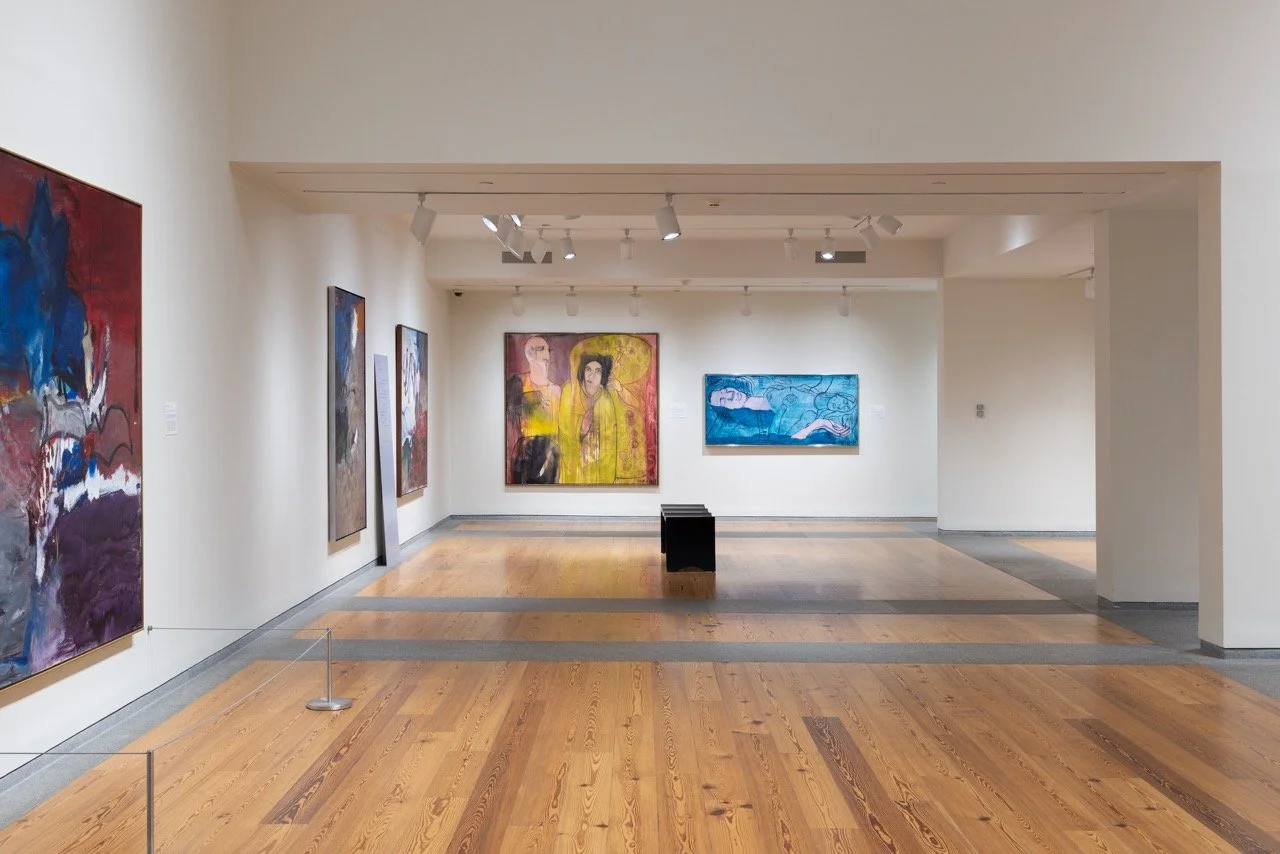
Also interesting is Koch’s all-male list of New York School painters who influenced these poets: Jackson Pollock, Willem de Kooning, Barnett Newman, Clyfford Still, Mark Rothko and Adolph Gottlieb. Nowhere are women such as Lee Krasner or Grace Hartigan mentioned, despite the fact that they were already singular forces on the abstract expressionist scene. Koch is 84 now, and he would do well to visit the Portland Museum of Art, where “Grace Hartigan: The Gift of Attention” is on view through January 11.
The exhibition makes clear the symbiotic relationships between painters and poets during those years. But it also illuminates Koch’s thesis that both fields in that era expanded human consciousness and perception. The painters were striving toward methods of expressing inner experience in ways that were visceral and immediate, not just academic and narrative. They chose gesture over representation, rhythm over rote, raw energy over minute observation of details. The poets were also experimenting with poetic form to convey the cacophony and randomness of everyday life in the city, blending pop culture, quotidian moments, humor and spontaneous associations to describe the immediacy of the modern.
Hartigan was mostly self-taught, though she did study for a time under Isaac Lane Muse, a painter who is hardly known today, but who introduced her to the artists of the Abstract Expressionist scene. In a way, this freed her to be more independent in the development of her style. “I want an art that is not ‘abstract’ and not ‘realistic,’” she wrote in 1956. At the time, these were considered distinctly separate camps, which may be one reason (besides the white male sexism of the era) that she goes unmentioned in Koch’s Times article. Exactly what Hartigan meant by her statement, however, can be seen in a painting such as “East Side Sunday” (1956), which is clearly a still life but one we perceive through a jumble of abstract, fractured planes that refuse either label.
The artist moved to New York in 1945 with her son from a failed marriage and lived “on oatmeal and bacon ends.” Despite her poverty, or perhaps because of it, she became fascinated with street life, announcing that “I have found my ‘subject.’ It concerns that which is vulgar and vital in American modern life.” Hence works like “Grand Street Brides” (1954), one of several paintings that satirized the institution of marriage, which she despised, by depicting the blissful artifice peddled by mannequins in nuptial regalia and posed in bridal-shop windows.
Her relationship with poets is made manifest in “Masquerade,” in which she portrays a group of costumed poets and painters that includes O’Hara, Ashbery, poet Daisy Aldan and her partner Olga Petroff, painter Jane Freilicher, Richard Miller and Floriano Vecchi (respectively, publisher with Aldan of the arts journal Folder, and its printer at Tiber Press) and poet James Merrill, a poet who also was Hartigan’s premier benefactor, having been born to the co-founder of Merrill Lynch.
This painting hangs catercorner to “Grand Street Brides,” and it’s interesting to compare the two. “Brides” feels static and posed, its figures almost cadaverous, while it also references art history, particularly in a small figure to the right that resembles Velázquez’s Infanta Margarita Teresa (Hartigan had, for a period, delved into Old Masters, particularly Velàzquez and Goya). In “Masquerade,” the brushstrokes are looser, making the figures feel playful and alive, and the poses are more casual and flirtatious. It should also be said that many of these figures — O’Hara, Aldan and Petroff, Merrill — were queer, which adds to the painting’s smirking, insouciant attitude. But masquerade also implies “mask,” which could in turn allude to hiding one’s sexuality.
The exhibition includes various cover illustrations created by Hartigan for Folder, as well as poems that inspired some of the paintings (the show uses the word “ekphrasis” to emphasize the relation between visual and written forms of single works). So, we get, for instance, the stunning “Snow Angel” (1960), which draws from Guest’s poem of the same name, where we find the lines “underground fires are lit” and “In the dark sits the first Angel of snow / tomorrow in the outraged sky / his form.” Hartigan depicts those fires in the red bottom right corner of the painting, and the angel as a meandering black-and-purple line against the white snowy sky in the upper left. The latter could be interpreted as wings, but it also feels distinctly calligraphic, begging the question: is this painting or writing or both?
“Snow Angel” is one of her fully abstract works. “Black Crows (Oranges No. 1),” from 1952, on the other hand, is based on a poem by O’Hara and mixes painterly abstraction with the actual letter type of the poem painted over it. Yet the words are almost illegible in parts, as if they recede into the painting and the actual material of paint comes forth. Whether she intended this or not, it is a way of effectively articulating the intimate relationships enjoyed by these painters and poets, and the inseparability of each one’s work from the other.
“The Gift of Attention” is a gorgeous show. But like Hartigan herself, it resists classification. Art historically referenced works like “Persian Jacket” (1952) or “Grand Street Brides” mix with works that are primarily based on poems such as “Dido” (a 1960 painting based on Guest’s “Dido to Aeneas”) and “The Hero Leaves His Ship” series of lithographs from that same year (based on another Guest poem of that name). For me, Hartigan was most exciting when she jettisoned representation all together in paintings like “Dido” and “Orange Field” (1958). But I appreciate the fluidity she practiced between pure abstraction and the mixture of figuration and abstraction.
I am moved to study Hartigan more, if for no other reason than to better understand how and why she chose one particular genre over another to express the aims of each painting. This is not apparent to me from this show, nor does the show attempt to answer that question. Perhaps it’s as simple as the fact that experimentation is always in flux. I’ve been back three times and will return again. I do get the sense that, no matter what genre Hartigan was working in, the paintings do exhibit Koch’s observation that “meaning nonetheless buzzes and flutters through them like insects flying through the evening air.” The contemplation of the mystery of how that happens makes this show a highlight of the holiday season.
Jorge S. Arango has written about art, design and architecture for over 35 years. He lives in Portland and can be reached at jorge@jsarango.com. This column is supported by The Dorothea and Leo Rabkin Foundation.
IF YOU GO
“Grace Hartigan: The Gift of Attention,” Portland Museum of Art, 7 Congress Square, Portland. Through Jan. 11. For more, call 207-775-6148 or portlandmuseum.org.