PMA’s Winslow Homer exhibit recasts the artist in a fresh medium | Column Portland Press Herald — Maine Sunday Telegram
Posted September 2
Jorge S. Arango
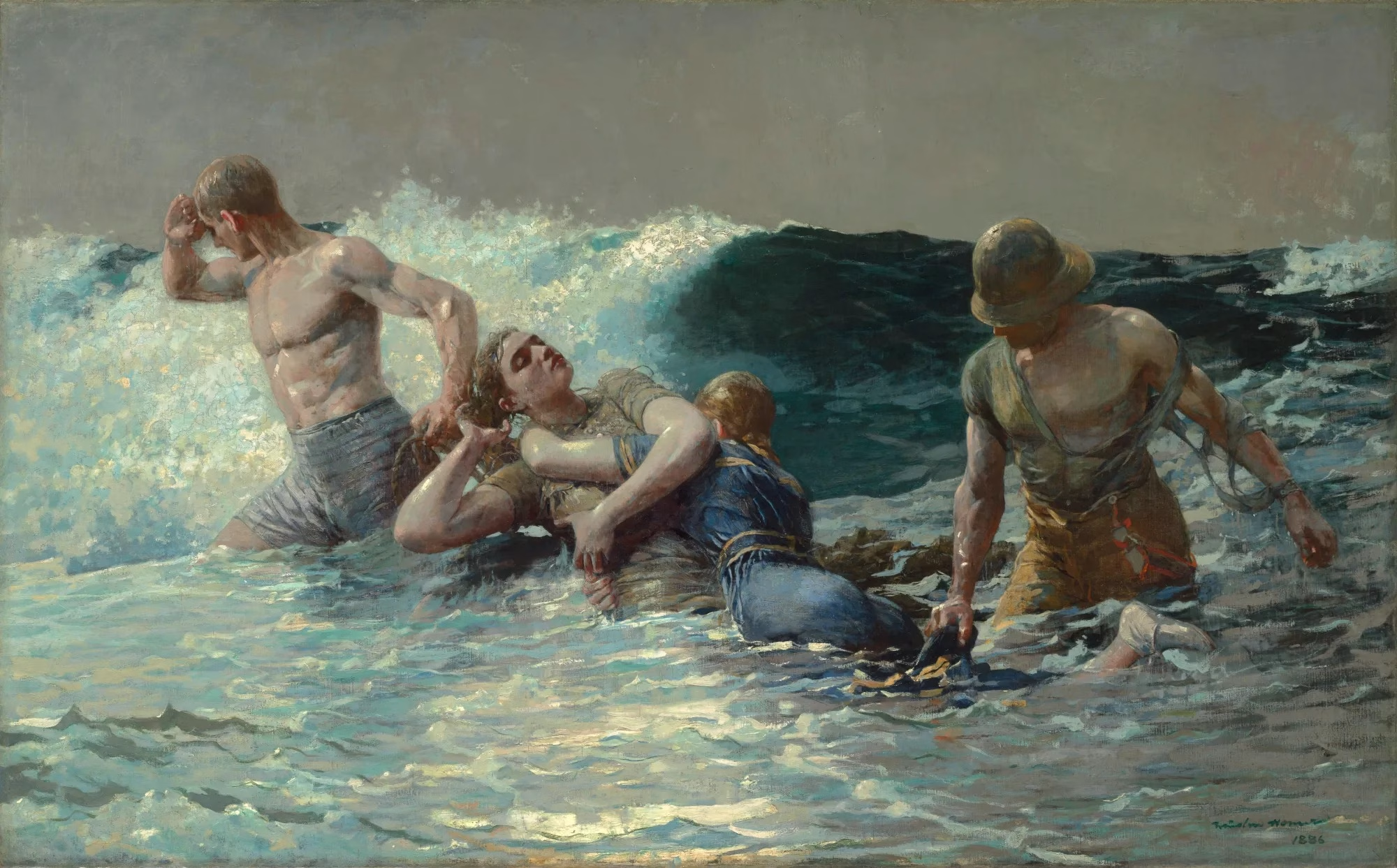
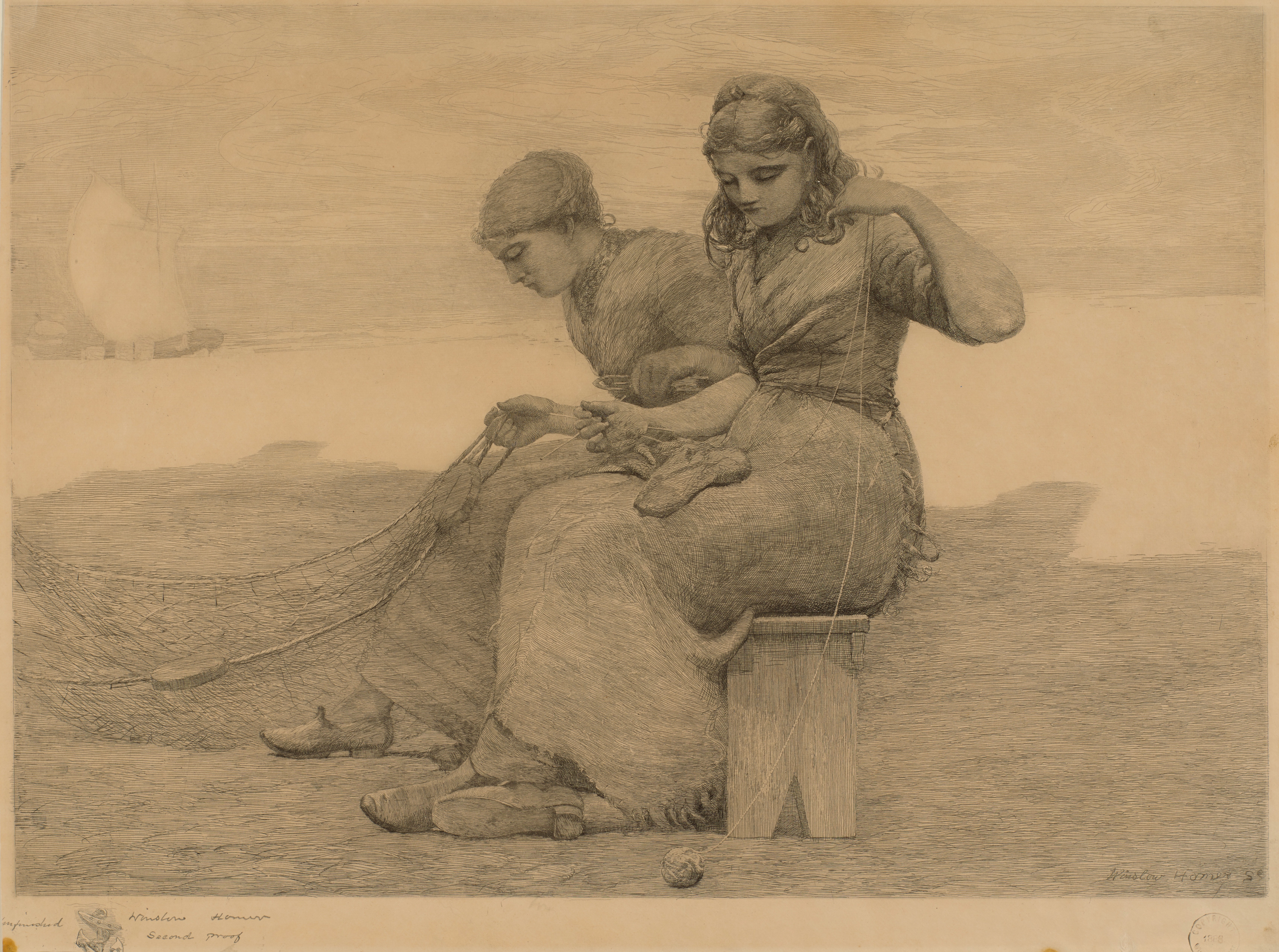
There are so many levels of wonderful (and wonderment) in the Portland Museum of Art’s current major exhibition, “Winslow Homer: Painter, Etcher” (through Oct. 18), that it’s hard to know where to begin. It is a rare show indeed, one that merits frequent return visits, which I can guarantee will unfold new discoveries each time. But you have only until its closing to enjoy the show, as this is, unfortunately, its only venue. After it closes, loans like the Clark Institute’s “Undertow” of 1886 and “Mending the Nets,” an 1882 work from the National Gallery of Art in Washington, D.C., return home.
Arguably, one of the most important accomplishments of the show is to completely recast Homer’s etching as integral to his entire oeuvre. What co-curator Ramey Mize (with Judith C. Walsh) points out in her introductory essay is that Homer “later asserted that his etchings, along with some of his watercolors, were ‘as good work… as I ever did.’”
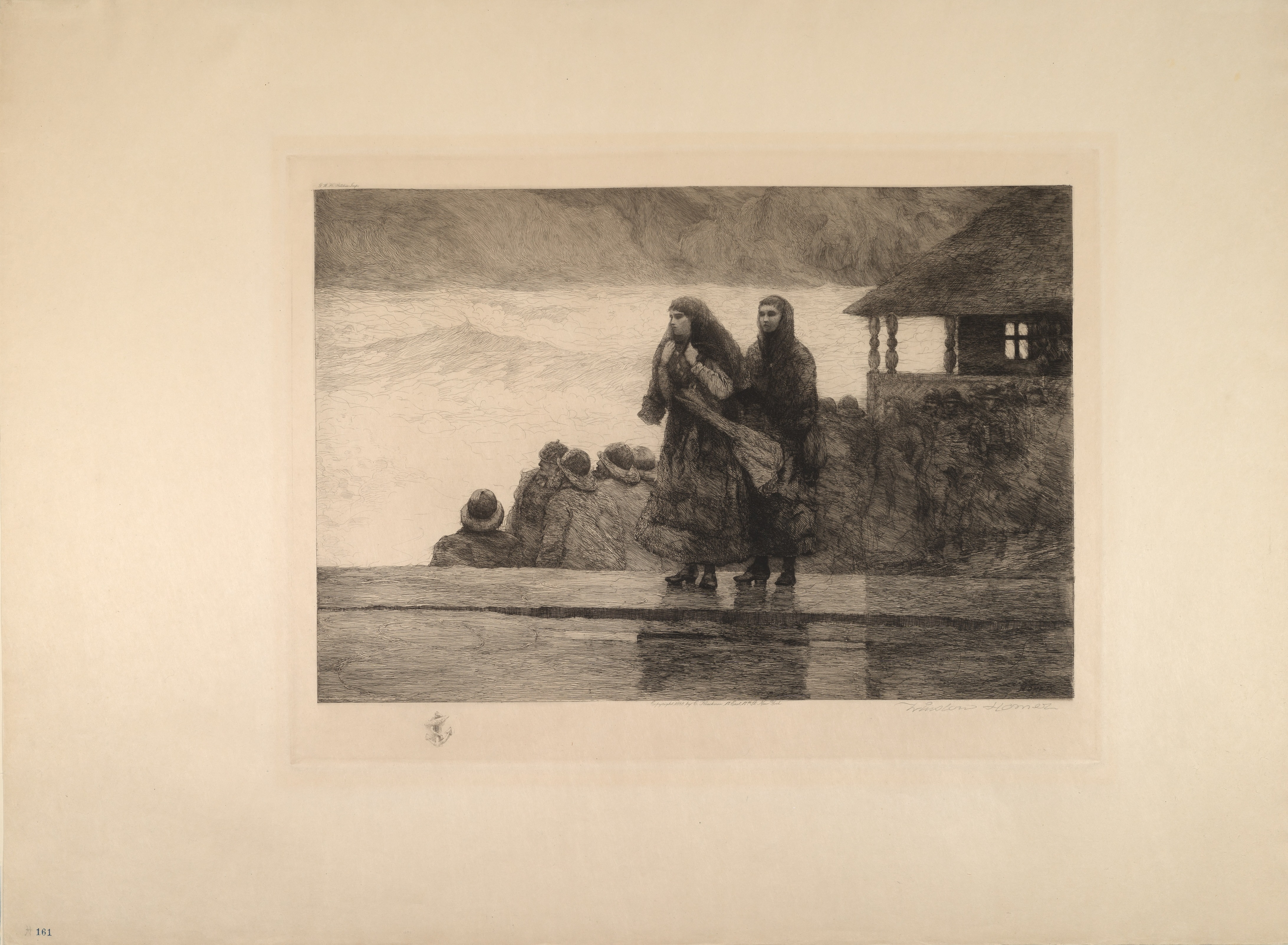
Yet for over a century, the conventional view has been that Homer created etchings from his great paintings as a purely commercial venture, a way to ride on the coattails of the success of his paintings and make some extra money (not that this, in itself, is a bad thing of course). Over and over again in this exhibition, we see the artist returning to works such as “The Life Line,” “Perils of the Sea” and “Mending the Tears” to further explore his subject matter and experiment with multiple etching techniques. At other times, we can see that he was developing his etchings concomitantly with the paintings as a way to work out details of composition, transparency and opacity.
Homer was not, of course, unaware of his prints’ economic opportunities. He relied on master etchers to print the copper plaques he would create at his studio at Prout’s Neck, often working side by side with them to achieve the effects he wanted. As Walsh points out in her essay, “From Idea to Impression: The Mechanics of Winslow Homer’s Etchings,” his 1844 move from printer George Wistar Hodge Ritchie to the studio of Christian Klackner was an art, as well as business, decision. “With Klackner’s involvement,” she points out, “Homer’s etchings bespeak an increasing concern with finish to enhance their marketability.”
Another delight of the show is to illustrate the multiplicity of effects possible through each printer’s interpretative and material choices. It’s evident early on in a grouping of the 1884 oil-on-canvas masterpiece “The Life Line,” which is exhibited next to three etchings of the scene that, although all executed by Ritchie, are nevertheless made using three different colored inks.
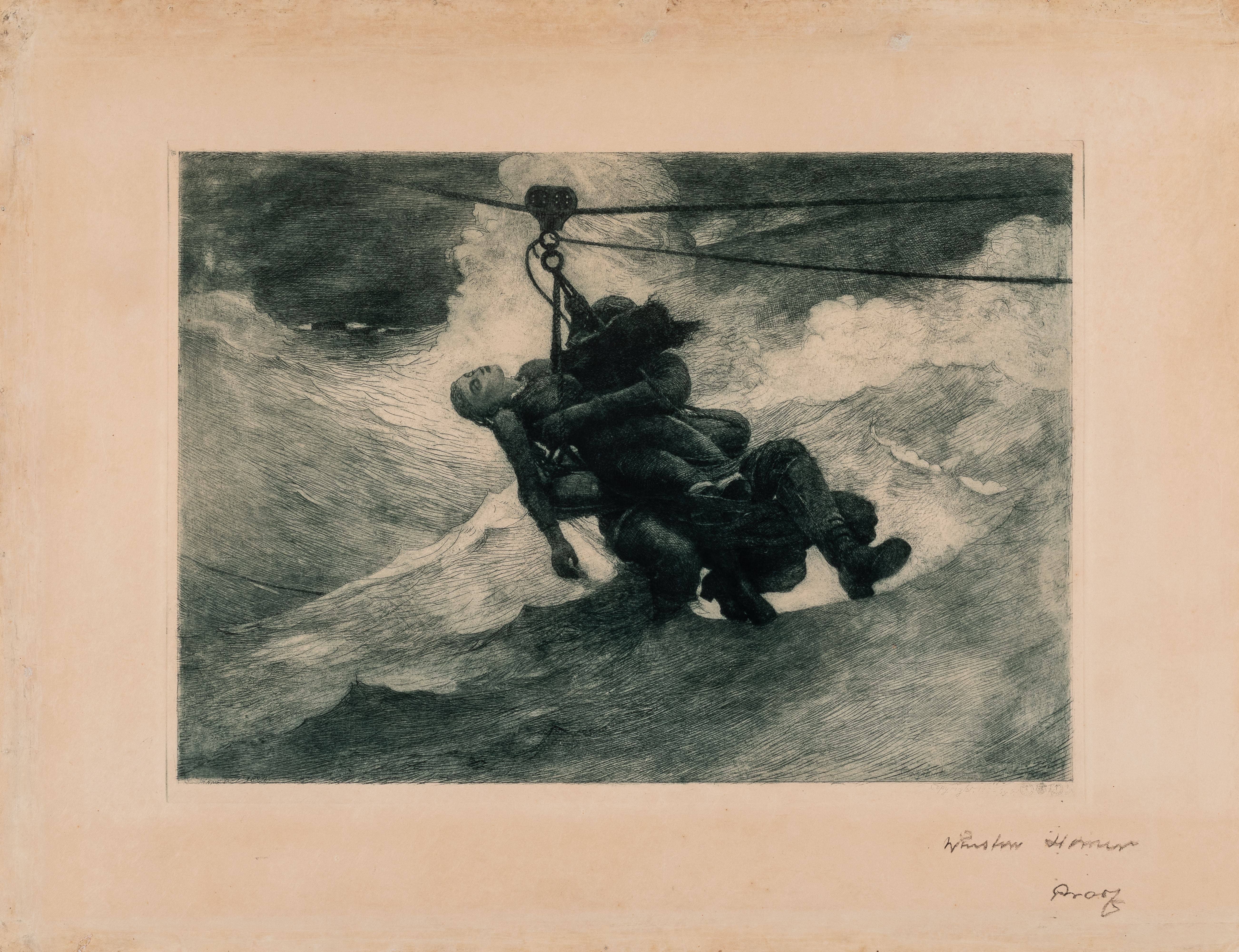
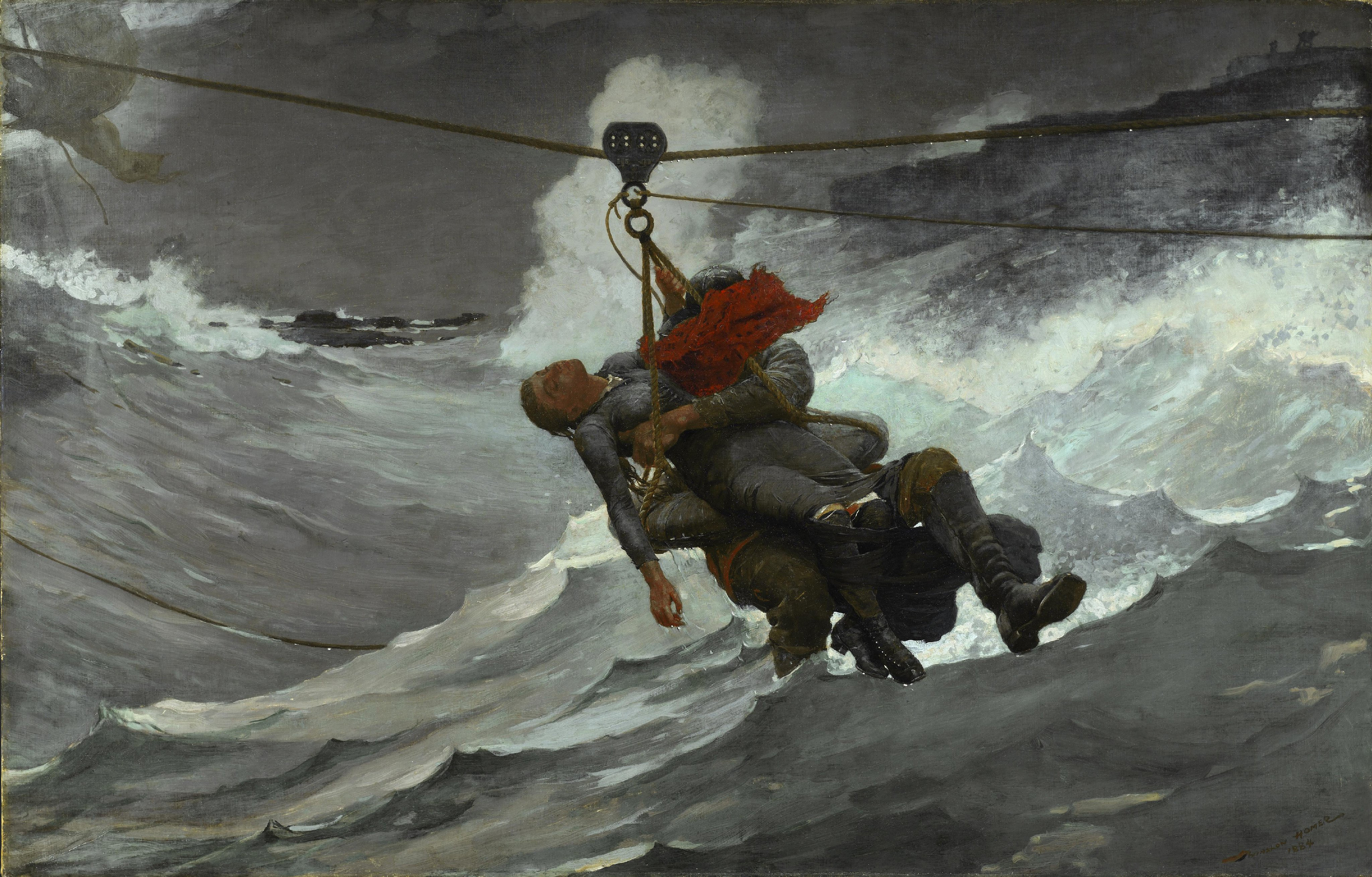
In the brown ink example of the same year, the sea seems less tempestuous and, because of the many blank areas, gives the impression that perhaps the sun is even beginning to break through the clouds. So it lacks the sense of urgency present in the others. In the artist’s proof (dated 1884/1887), the blue ink Ritchie employed animates the waves in a much more intensely dramatic way, to the point where when we look at it, it’s the roiling ocean we notice first, rather than the dramatic rescue taking place at the center of the picture. And in another version executed in black ink (also dated 1884/1887), we see a continuity amongst all compositional elements that brings the entirety of the scene to life.
Homer revisited this theme five years later in some of his last etchings. “Perhaps he was dissatisfied with the earlier print… and wished to do better,” writes Kathleen A. Foster, in her catalog essay, “Saved, 1889,” but “more importantly, the romance in the subject continued to abide in his imagination.” In these Klackner strikes, Homer heightened the stakes by enlarging the figures to bring the melodrama forefront, eliminating the shipwreck in the distance of the original painting.
It is worth quoting Foster at length here: “The power of the preparatory drawing resonates in the return of the sailor’s beefy hand on the shoulder of the woman, making explicit a grip on her body that had been discreetly avoided in the painting. Her dangling, wet tresses, previously eliminated…now tangle intimately below his fingers… Although his embrace is more explicit, the sailor has been, by contrast, suppressed… his head entirely covered by the fringed shawl that now creates a shaggy, oddly monstrous silhouette. The result is a stronger emotional engagement with the figure of the beautiful maiden in distress…”
Some of Homer’s prints preceded the painting that is today better known. The wood engraving of “Sharpshooter,” first appeared in an 1862 issue of Harper’s Weekly. In the 1863 oil-on-canvas work we notice that Homer eliminated the canteen hanging on the tree in which the subject is perched and aiming his gun. He also fills out the pine needle-covered branches of the tree in the background. Homer was just embarking on his painting career at that time, and we can see not only the relation between print and painting but, significantly, the differences.
In this same room, we also begin to notice how, typically, Homer’s prints contained much more detail and visual content than his paintings. Both the engraving and the painting of “The Recess (Kept In)” (1873) depict a young boy in a classroom with a somewhat distracted teacher looking out a window.
In the engraving, the blackboard bears numbers and alphabet letters, tables and benches are littered with books, a map of North and Central America hangs on the wall and, outside the window, we see at least four children under a tree. In the painting, however, Homer erased all chalk markings from the blackboard, reduced the number of books strewn about, eliminated the map completely, and the children and landscape outside the window have been simplified. The teacher suddenly dons a loosely painted apron and, in general, there is less minute precision and more painterliness evident than in the print.
This sparked contemplation about the two approaches of an etcher and a painter. Printing techniques had perhaps become more refined by then — etching and engraving enjoyed a revival between 1850 and 1930 — but remained essentially the same. Yet the field of painting was undergoing a radical revolution that began with the looser, more expressive style pioneered by painters such as Honoré Daumier, Edouard Manet, François Millet, James McNeil Whistler and Berthe Morisot (and later made even more radical by the Impressionists in the 1870s).
Homer had to have been aware of these changes, even though he would not make his first trip to England until 1881, and his painting showed it; specifically the way composition became more reductive and there was less emphasis on a wealth of realistic detail. So, I thought, Homer was practicing printing in fairly conventional ways (until he began innovating with multiple techniques in single works), while in painting, he was experimenting with what was new, exciting, perhaps even avant-garde.
Much of the excitement of the show, of course, rests on our opportunity to contrast and compare: paintings with engravings and etchings, difference between various strikes of the same work and so on. But the show also embodies new scholarship, some of it covered by Walsh in her essay. Walsh is an expert on paper, and she was able, though diligent study and examination, to document who printed what and when. Klackner, for instance, favored pale cream, handmade Japanese vellum that mimicked true parchment, while Ritchie often employed “thick blued-white Western machine-made paper.”
The show also features an incredibly instructive video on the various printing/etching techniques Homer employed, including stopping out, roulette, drypoint, remarques, burnishing and so on (techniques also explained at the back of the impressively informative exhibition catalog). Honestly, this is what we would call a “blockbuster” of a show. It follows on another beautiful exhibition at the Museum of Fine Arts, Boston, on Homer watercolors last year. Together they prove that there’s simply no end to Homer’s talents and creativity and what we can discover about them.
Jorge S. Arango has written about art, design and architecture for over 35 years. He lives in Portland and can be reached at [email protected]. This column is free to access through support by The Dorothea and Leo Rabkin Foundation.
Related
-

Press Release: Portland Museum of Art to Open Temporary Open-Air Pavilion
FOR IMMEDIATE RELEASE: September 21, 2026CONTACT: [email protected] Portland Museum of Art to Open Temporary Open-Air Pavilion... -

The 2026 Summer Party: A Perfect Maine Evening
August 7, 2026
Thanks to everyone who joined us for the PMA’s 2026 Summer Party, inspired by Winslow Homer:...